Today's
EarthStation1.com 15% Off Commemorative Memorial Title: TV
Commercials: The Cable Age Classics II DVD, Download, USB Drive
Today, May 15, 2026
May 15: National Chocolate Chip Day: --
We might not know which came first - the chicken, or the egg - but
when it comes to chocolate chips, and their namesake cookie, the
history is well-documented, and it might not be what you think!
Chocolate chips actually came after the chocolate chip cookie, and
despite their ubiquity, are likely younger than your grandmother
(they were first marketed in 1940!). The chocolate chip cookie was
invented by American chef Ruth Graves Wakefield in 1938. She
invented the recipe during the period when she owned the Toll
House Inn, in Whitman, Massachusetts. In this era, the Toll House
Inn was a popular restaurant that featured home cooking. A myth
holds that she accidentally developed the cookie, and that she
expected the chocolate chunks would melt, making chocolate
cookies. That is not the case; Wakefield stated that she
deliberately invented the cookie. She said, "We had been
serving a thin butterscotch nut cookie with ice cream. Everybody
seemed to love it, but I was trying to give them something
different. So I came up with Toll House cookie." She added
chopped up bits from a Nestle semi-sweet chocolate bar into a
cookie. The original recipe in Toll House Tried and True Recipes
is called "Toll House Chocolate Crunch Cookies".
Wakefield gave Nestle the recipe for her cookies and was paid with
a lifetime supply of chocolate from the company. The recipe spread
like wildfire, and after a few years of selling their semi-sweet
chocolate bars with a chopping tool (for easy chunking of the
bar), Nestle went one step further by introducing chocolate
"morsels" to the world. With such a history, and with so
much mass appeal, it's no surprise that this kitchen delight
deserves celebration, and that's why, on May 15, we've got
National Chocolate Chip Day. On Sale @ 15% Off Discount Till
Midnight PT!
https://store.earthstation1.com/tv-commercials-the-cable-age-classics-ii-dvd.html
Today's
EarthStation1.com 15% Off Commemorative Memorial Title: Sacred
Serpents: Snake Worship Documentaries DVD, MP4, USB Drive
Today, May 15, 2026
May 15: Bring Flowers To Someone Day: --
The gift of flowers is a universal way of showing love,
appreciation, sympathy, or thanks. Today is the perfect day to
explore the history of giving flowers and the meanings behind
them. You won't need a reason to give flowers to someone - any or
no reason will do! Everyone is encouraged to spread joy through
beautiful blooms. Buy an arrangement from a florist or pick blooms
from your garden. You must hand over the flowers yourself. It adds
a personal touch to a thoughtful gift. The language of flowers is
called Floriography. Every flower is thought to have its special
meaning, which can change due to its color or variety. Lady Mary
Wortley, a feminist poet married to the British Ambassador of
Turkey, wrote about this and other fascinating customs of the
people of Turkey in a series of letters. 'Selem' was a tradition
that originated in Turkish harems. It was a secret flower language
used for communication by harem women and decoded by attaching
rhyming words to certain flowers and other objects. This form of
communication became a big hit in the conservative Victorian era,
which lasted from 1837 to 1901. In response to the rigid social
constructs of the time that valued chastity, many courtships
consisted of secret affairs and flirtations. Couples embraced this
creative and secretive way of communicating, as it was forbidden
to openly talk about such daring pursuits. The craze soon traveled
across the seas and between 1827 and 1923 there were numerous
flower dictionaries published in the U.S. Magazines like "The
Atlantic" regularly wrote about flower codes. Then came World
War I. Producing food and munitions instead of flowers became the
focus and the fad died out. Nevertheless, the practice has still
taken root. Today, we continue to associate meanings with certain
flowers. Red roses mean love. Chrysanthemums mean friendship.
Rosemary means remembrance. With many other flowers symbolizing
many more feelings, there'll be no shortage of blooms that you can
give to someone not just today but on any day of the year. On Sale
@ 15% Off Discount Till Midnight PT!
https://store.earthstation1.com/sacred-serpents-snake-worship-documentaries--dvd-mp4-us4.html
Today's
EarthStation1.com 15% Off Commemorative Memorial Title: Classic
Family Values Films 1934-1957 DVD, Video Download, USB Drive
Today, May 15, 2026
May 15: International Day Of Families
(International Family Day): -- Founded by the United Nations (UN)
in 1994, this day honors the importance of families which, both
traditional and non-traditional, are the foundation of society.
Our most formative years are spent with our families and those
people are likely the most important people in our lives, so they
should be celebrated. Let's spend time today finding ways to
protect the family unit in society by starting at home with our
own! Step into a world where the heart of our communities - our
families-takes center stage It offers warmth and laughter that
fill living rooms and the vibrant energy of community gatherings
worldwide. This day shines a light on how traditional and
non-traditional families form the backbone of communities around
the globe. It's about understanding and addressing the economic,
social, and demographic challenges that families face today. Every
year, a unique theme focuses on different aspects of family life
and the issues they encounter. They range from poverty and
homelessness to the impact of migration and the importance of
gender equality within family units. In essence, the International
Day of Families is a reminder of families' critical role in
shaping societies and supporting individuals throughout their
lives. It's a call to action to ensure families worldwide have the
support they need to thrive. The journey to recognizing this day
began in the 1980s when the United Nations started to focus on the
evolving structure of families and the challenges they come
across. By 1989, the UN General Assembly declared that year as The
International Year of the Family, leading to the establishment of
the International Day of Families in 1993. This day was set to
encourage the international community to better understand the
family's pivotal role as society's basic unit and address the
challenges families worldwide face. The aim is to celebrate the
diversity of families and reinforce the idea that there is no
single model for what a family should be. In essence, the
International Day of Families reminds us of the invaluable support
system that families provide. It's a day to celebrate the love,
bond, and support we share within our families. On Sale @ 15% Off
Discount Till Midnight PT!
https://store.earthstation1.com/classic-family-values-films-193419341957.html
Today's
EarthStation1.com 15% Off Commemorative Memorial Title: WWII
Films: Industry & Labor Back The Attack! DVD, Download, USB
Drive
Today, May 15, 2026
May 15: National Nylon Stocking Day: -- A
day to recognize the stylish variety and color available on
National Nylon Stocking Day. Many may not remember ever hearing
the term "nylon stockings." Varying in color, design,
and transparency, a nylon stocking (also known as hose) is a
close-fitting, variously elastic garment worn the same as socks or
tights. Stockings worn before the 1890s were made of woven cloth
such as cotton, linen, wool, or silk. Before the 1920s, women's
stockings were worn for warmth. As hemlines of women's dresses
rose in the 1920s, women began to wear stockings over their
exposed legs. These 1920s stockings were sheer, made first of silk
or rayon, followed by nylon after 1940. Chemical company DuPont's
introduction of nylon in 1939 began a high demand for stockings in
the United States. As nylon stockings were inexpensive, durable,
and shear, up to 4 million pairs would be purchased each day. On
February 11, 1942, as America entered World War II, DuPont ceased
production of nylon stockings and switching its focus to the
manufacture of parachutes, airplane cords, and rope. This created
a mass shortage followed by a black market for stockings. At the
end of World War II, DuPont resumed production of the stockings
but could not meet the demand leading to nylon riots in American
stores. In time, DuPont was able to increase its output. In the
1940s and 1950s, the first pantyhose made its appearance. Film and
theater productions had stockings sewn to the briefs of actresses
and dancers, as seen in popular films such as Daddy Long Legs.
Unlike stockings, pantyhose did not require a garter belt to hold
the stockings up. Pantyhose were introduced in 1959, providing a
convenient alternative to stockings which led to a decline in
their sales. In 1970, for the first time, United States sales of
pantyhose exceeded stocking sales and have remained the same ever
since. In 1987, there was a slight decline in sales in pantyhose
due to the newly invented hold-ups. However, they remain the most
purchased kind of hosiery. Today nylons come in every color and a
variety of styles. Show off your fashion sense with the latest
styles. Share using #NylonStockingDay to post on social media. On
Sale @ 15% Off Discount Till Midnight PT!
https://store.earthstation1.com/wwii-films-industry-amp-labor-back-the-attack-dvd.html
Today's
EarthStation1.com 15% Off Commemorative Memorial Title: Mrs.
Fenwick Went To Washington: Millicent Fenwick DVD, Download, USB
Today, May 15, 2026
May 15: Break The Glass Ceiling Day --
It's time to break the glass ceiling! The often-invisible systemic
barriers that exist to keep women and underrepresented communities
from professional advancement. World Economic Forum's 2021 Global
Gender Gap Report estimates that it will take an average of 135.6
years for women and men to reach parity on a range of factors
worldwide. That's why Break The Glass Ceiling Day is on May 15,
the 135th day of the year. And that's why we need to do more than
just break through. We are dismantling outdated definitions of
success. For all people who identify as women, for all
historically marginalized communities. We are championing living
by your own values and achieving them by your own standards.
Because there's more than one way to break the glass ceiling.
Today is about encouraging action. Our mission is not only
uplifting women in the workplace but all underrepresented
communities, including multicultural, transgender, and queer
communities. As we continue on this journey, we must ask three
crucial questions: 1) How do we see women as equals and role
models for ALL - not just other women; 2) How do we make space for
diverse, even conflicting, definitions of success? 3) How do we
use this day to inspire continued action across every single day
of the year? Let's celebrate the first-ever #BTGCD and redefine
success on our own terms. If we continue down the current path, it
will take over 135 years to achieve gender pay parity. That's why
we celebrate Break The Glass Ceiling Day on May 15, the 135th day
of the year. Despite being a long-awaited national holiday, the
idea of 'breaking the glass ceiling' has been around since the
'70s. But recently, the conversation has been declining. Let's
reignite the conversation and change! On Sale @ 15% Off Discount
Till Midnight PT!
https://store.earthstation1.com/mrs-fenwick-went-to-washington-dvd-millicent-fenwick.html
Today's
EarthStation1.com 15% Off Commemorative Memorial Title: Monarchy
In The UK: British Royal History MP4 Video Download DVD Set
Today, May 15, 2026
May 15, 1536: The English Monarchy (The
Monarchy Of The Kingdom Of England): Anne Boleyn, Queen Of
England: The Arrest And Imprisonment Of Anne Boleyn, Queen Of
England: The Trial Of Anne Boleyn, Queen Of England: -- Anne
Boleyn, Queen Of England and wife of King Henry VIII, stands trial
in London on charges of treason, adultery and incest; she is
condemned to death by a specially-selected jury. On January 25,
1533, King Henry VIII Of England formally married Anne Boleyn,
having secretly married on November 14, 1532. On May 23, 1533,
newly appointed Archbishop of Canterbury Thomas Cranmer declared
Henry and Catherine's marriage null and void; five days later, he
declared Henry and Anne's marriage valid. Shortly afterwards, the
Pope decreed sentences of excommunication against Henry and
Cranmer. As a result of this marriage and these excommunications,
the first break between the Church of England and Rome took place
and the Church of England was brought under the King's control.
Anne was crowned Queen Of England on 1 June 1533. She has been
called "the most influential and important queen consort
England has ever had", as she provided the occasion for Henry
VIII to annul his marriage to Catherine Of Aragon and declare the
English church's independence from Rome. Their daughter eventually
became Queen Elizabeth I Of England, called the Virgin Queen and
Good Queen Bess, the last of the five monarchs of the House of
Tudor. Anne Boleyn was Queen Of England from 1533 to 1536 as the
second wife of King Henry VIII. Their marriage, and her execution
by beheading, made her a key figure in the political and religious
upheaval that was the start of the English Reformation. Anne was
the daughter of Thomas Boleyn, 1st Earl of Wiltshire, and his
wife, Lady Elizabeth Howard, and was educated in the Netherlands
and France, largely as a maid of honour to Queen Claude of France.
Anne returned to England in early 1522, to marry her Irish cousin
James Butler, 9th Earl of Ormond; the marriage plans were broken
off, and instead she secured a post at court as maid of honour to
Henry VIII's wife, Catherine Of Aragon. In February or March 1526,
Henry VIII began his pursuit of Anne. She resisted his attempts to
seduce her, refusing to become his mistress, which her sister Mary
had been. It soon became the one absorbing object of Henry's
desires to annul his marriage to Catherine so he would be free to
marry Anne. When it became clear that Pope Clement VII would not
annul the marriage, the breaking of the Catholic Church's power in
England began. On September 7, she gave birth to the future Queen
Elizabeth I. Henry was disappointed to have a daughter rather than
a son but hoped a son would follow and professed to love
Elizabeth. Anne subsequently had three miscarriages, and by March
1536, Henry was courting Jane Seymour. In order to marry Seymour,
Henry had to find reasons to end the marriage to Anne. Henry VIII
had Anne investigated for high treason in April 1536. On May 2 she
was arrested and sent to the Tower of London, where she was tried
before a jury of peers - which included Henry Percy, her former
betrothed, and her own uncle Thomas Howard, 3rd Duke of Norfolk -
and found guilty on May 15. She was beheaded four days later.
Modern historians view the charges against her, which included
adultery, incest and plotting to kill the king, as unconvincing.
Some say that Anne was accused of witchcraft but the indictments
make no mention of this charge. After the coronation of her
daughter, Elizabeth, Anne was venerated as a martyr and heroine of
the English Reformation, particularly through the works of John
Foxe. Over the centuries, she has inspired, or been mentioned, in
many artistic and cultural works and thereby retained her hold on
the popular imagination. On Sale @ 15% Off Discount Till Midnight
PT!
https://store.earthstation1.com/monarchy-in-the-uk-british-royal-family-history-films-dvd.html
Today's
EarthStation1.com 15% Off Commemorative Memorial Title: Eclipse Of
The Century Over Mauna Kea Observatory July 11 1991 MP4 DVD
Today, May 15, 2026
May 15, 1836: Eclipses: Solar Eclipses:
Annular Eclipses: The Solar Eclipse Of May 15, 1836 (Bailey's
Beads Eclipse): -- Francis Baily observes "Baily's Beads"
during an annular eclipse. The Baily's Beads Effect, also known as
The Diamond Ring Effect, is a feature of total and annular solar
eclipses. As the Moon covers the Sun during a solar eclipse, the
rugged topography of the lunar limb allows beads of sunlight to
shine through in some places while not in others. An annular
eclipse, like a total eclipse, occurs when the Sun and Moon are
exactly in line with Earth. During an annular eclipse, however,
the apparent size of the Moon is not large enough to completely
block out the Sun. Totality thus does not occur; the Sun instead
appears as a very bright ring, or annulus, surrounding the dark
disk of the Moon. Annular eclipses occur once every one or two
years, not annually. Their name comes from the Latin root word
anulus, meaning "ring", rather than annus, for "year".
The Baily's Beads effect is named after Francis Baily, who
explained the phenomenon in 1836. Although Baily is often said to
have discovered the cause of the feature which bears his name, Sir
Edmond Halley made the first recorded observations of Baily's
beads during The Solar Eclipse Of May 3, 1715 (Halley's Eclipse).
Halley described and correctly ascertained the cause of the
effect. The diamond ring effect is seen when only one bead is
left, appearing as a shining "diamond" set in a bright
ring around the lunar silhouette. Lunar topography has
considerable relief because of the presence of mountains, craters,
valleys, and other topographical features. The irregularities of
the lunar limb profile (the "edge" of the Moon, as seen
from a distance) are known accurately from observations of grazing
occultations of stars. Astronomers thus have a fairly good idea
which mountains and valleys will cause the beads to appear in
advance of the eclipse. While Baily's beads are seen briefly for a
few seconds at the center of the eclipse path, their duration is
maximized near the edges of the path of the umbra, lasting 1-2
minutes. After the diamond ring effect has diminished, the
subsequent Baily's beads effect and totality phase are safe to
view without the solar filters used during the partial phases. By
then, less than 0.001% of the Sun's photosphere is visible.
Observers in the path of totality of a solar eclipse see first a
gradual covering of the Sun by the lunar silhouette for just a
small duration of time from around one minute to four minutes,
followed by the diamond ring effect (visible without filters) as
the last bit of photosphere disappears. As the burst of light from
the ring fades, Bailey's beads appear as the last bits of the
bright photosphere shine through valleys aligned at the edge of
the Moon. As the Baily's beads disappear behind the advancing
lunar edge (the beads also reappear at the end of totality), a
thin reddish edge called the chromosphere (the Greek chroma
meaning "color") appears. Though the reddish hydrogen
radiation is most visible to the unaided eye, the chromosphere
also emits thousands of additional spectral lines. On Sale @ 15%
Off Discount Till Midnight PT!
https://store.earthstation1.com/eclipse-of-the-century-over-mauna-kea-observatory-july-11-1991-1119914.html
Today's
EarthStation1.com 15% Off Commemorative Memorial Title: The
Divided Union: American Civil War TV Series MP4 Download DVD Set
Today, May 15, 2026
May 15, 1862: The American Civil War (The
Civil War, The War Between The States): The Lower Seaboard Theater
Of The American Civil War: Battles Of The Lower Seaboard Theater
Of The American Civil War: New Orleans In The American Civil War:
The Capture Of New Orleans: General Order No. 28 (The Woman
Order): -- Union General Benjamin Butler, military governor of New
Orleans, issues an order that any Southern woman showing
disrespect to Union soldiers or the U.S. would be regarded as a
"woman of the town plying her avocation", i.e. a
prostitute. This and other controversial acts by Butler set the
stage for his dismissal as military governor in December 1862.
This order was in response to various and widespread acts of overt
verbal and physical abuse from the women of New Orleans, including
cursing at and spitting on Union soldiers and pouring out chamber
pots on their heads from upstairs windows when they passed in the
street (with Admiral David Farragut being perhaps the most notable
victim of a chamberpot attack). There was no overt sexual
connotation in Butler's order, but its effect was to revoke the
protected status held by women under the social mores of the time,
which mandated that any "respectable" woman (i.e., a
non-prostitute) be treated with the extra degree of respect due a
lady, regardless of their own provocations. Under General Order
28, however, if a woman showed any form of insult or contempt
towards a Union soldier (even so much as turning her back when he
approached or refusing to answer his questions), the usual social
standards no longer applied, and she could be retaliated against
(either verbally or physically) as if she were a common
prostitute. The order produced the desired effect, as few women
proved willing to risk retaliation simply to protest the Union
presence; but it was seen as extremely draconian by everyone
except the Union soldiers in New Orleans, and provoked general
outrage in the South, as well as abroad, particularly in England
and France. On Sale @ 15% Off Discount Till Midnight PT!
https://store.earthstation1.com/the-divided-union-american-civil-war-tv-series-3-dual-layer-dvd3.html
Today's
EarthStation1.com 15% Off Commemorative Memorial Title: Bloody
Shenandoah: The Valley Campaign Of 1864 Civil War DVD, MP4, USB
Today, May 15, 2026
May 15, 1864: The American Civil War (The
Civil War, The War Between The States): The Eastern Theater Of The
American Civil War: The Valley Campaigns Of 1864 (The Shenandoah
Valley Campaigns Of 1864): The Lynchburg Campaign: The Battle Of
New Market: -- A makeshift Confederate army of 4,100 men,
including cadets from the Virginia Military Institute (VMI)
ordered in by Confederate General John C. Breckinridge, some of
them child soldiers no older than 15, the only time in American
history a school's student body was used as an organized combat
unit, attack the Union lines in The Battle Of New Market, fought
in New Market, Virginia, defeating the larger Army Of The
Shenandoah under Major General Franz Sigel and delaying the
capture of Staunton, Virginia by several weeks. The battle is
primarily remembered today as an event that has gone on to become
central to many of VMI's myths and traditions. On Sale @ 15% Off
Discount Till Midnight PT!
https://store.earthstation1.com/bloody-shenandoah-valley-campaign-of-1864-civil-war-dvd-mp18644.html
Today's
EarthStation1.com 15% Off Commemorative Memorial Title: Women's
Rights Women's Suffrage The Women's Movement MP4 Download DVD
Today, May 15, 2026
May 15, 1869: Feminism: The Feminist
Movement (The Women's Movement): Women's Suffrage In The United
States: -- Susan B. Anthony and Elizabeth Cady Stanton form the
National Woman Suffrage Association in New York City. It was
created in response to a split in the American Equal Rights
Association over whether the woman's movement should support the
Fifteenth Amendment to the United States Constitution. Founders
Anthony and Stanton opposed the Fifteenth Amendment unless it
included the vote for women. Men were able to join the
organization as members; however, women solely controlled the
leadership of the group. The NWSA worked to secure women's
enfranchisement through a federal constitutional amendment.
Contrarily, its rival, the American Woman Suffrage Association
(AWSA), believed success could be more easily achieved through
state-by-state campaigns. In 1890 the NWSA and the AWSA merged to
form the National American Woman Suffrage Association (NAWSA). On
Sale @ 15% Off Discount Till Midnight PT!
https://store.earthstation1.com/women39s-suffrage-amp-the-women39s-movement-dvd-mp4-usb-39394.html
Today's
EarthStation1.com 15% Off Commemorative Memorial Title: The Golden
Age Of Second Avenue DVD, MP4 Video Download, Flash Drive
Today, May 15, 2026
May 15, 1890: #BOTD: #HBD! Menasha
Skulnik, American actor, primarily known for his roles in Yiddish
theater in New York City, also popular on radio, playing Uncle
David on The Goldbergs for 19 years, as well as on many television
and Broadway, including successful runs in Clifford Odets's The
Flowering Peach and Harold Rome's The Zulu And The Zayda (June 4,
1970) is #born in Warsaw, Poland, Skulnik reportedly ran away at
the age of 10 to join a circus. In 1913 he emigrated to the United
States, and sometime after his arrival joined a Yiddish stock
company in Philadelphia, where his fellow actors included Molly
Picon, American actress of stage, screen, radio and television.
His diminutive stature (5'4"), high nasal voice, mannerisms
and appearance, made him a natural for comedy. Skulnik knew
exactly what he was in comedy: "I play a schlemiel, a dope.
Sometimes they call me the Yiddish Charlie Chaplin, and I don't
like this. Chaplin's dope is a little bit of a wiseguy. He's got a
little larceny in him. I am a pure schlemiel, with no string
attached." Skulnik was dubbed "The East Side's Chaplin"
by the New York Evening Journal in 1935. He collapsed on stage in
New Haven, Connecticut, during a dress rehearsal of a show he was
bringing to Broadway, and died several weeks later on June 4,
1970, in New York City, aged 80. He is buried in the Yiddish
theater section of the Mount Hebron Cemetery. On Sale @ 15% Off
Discount Till Midnight PT!
https://store.earthstation1.com/the-golden-age-of-second-ave-yiddish-theatre-in-america-dvd.html
Today's
EarthStation1.com 15% Off Commemorative Memorial Title: The Birth
Of Europe: Ice Age To 20th Century DVD, Video Download, USB
Today, May 15, 2026
May 15, 1891: Religion: The History Of
Religion: Abrahamic Religions: Christianity: The History Of Roman
Catholicism: Papal Encyclicals: Encyclicals Of Pope Leo XIII: The
Rerum Novarum (Latin: "Of Revolutionary Change In The World")
(The Rights And Duties Of Capital And Labor): -- Pope Leo XIII
defends workers' rights and property rights in the encyclical
Rerum novarum, the beginning of modern Catholic social teaching.
It was an open letter, passed to all Catholic Patriarchs,
Primates, Archbishops and bishops,that addressed the condition of
the working classes. It discussed the relationships and mutual
duties between labor and capital, as well as government and its
citizens. Of primary concern was the need for some amelioration of
"The misery and wretchedness pressing so unjustly on the
majority of the working class." It supported the rights of
labor to form unions, rejected socialism and unrestricted
capitalism, whilst affirming the right to private property. Though
the European upper class balked at this, members of the German
upper class, such as the anti-catholic politician Otto von
Bismarck and anti-liberal industrialist Alfred Krupp, adopted much
of The Rerum Novarum in social and economic policy, as a means of
stealing Catholic and progressive thunder. On Sale @ 15% Off
Discount Till Midnight PT!
https://store.earthstation1.com/the-birth-of-europe-european-history-from-the-ice-age-to-20th-centu20.html
Today's
EarthStation1.com 15% Off Commemorative Memorial Title: Daley: The
Last Boss: Chicago Mayor Richard J. Daley MP4 Download DVD
Today, May 15, 2026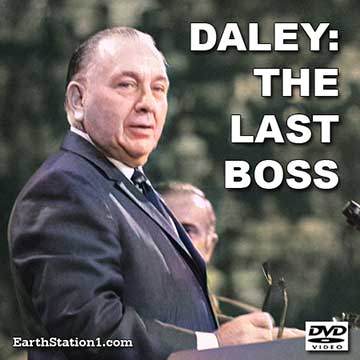
May 15, 1902: #BOTD: #HBD: Richard J. Daley, American politician who served as the mayor of Chicago from 1955, and the chairman of the Cook County Democratic Party Central Committee from 1953, until his death (d. December 20, 1976) is #born Richard Joseph Daley in Bridgeport, a working-class neighborhood of Chicago, Illinois. He has been called "the last of the big city bosses" who controlled and mobilized American cities. Daley was Chicago's third consecutive mayor from the working-class, heavily Irish-American South Side neighborhood of Bridgeport, where he lived his entire life. He was the patriarch of the Daley family, whose members include Richard M. Daley, another former mayor of Chicago; William M. Daley, a former United States Secretary of Commerce; John P. Daley, a member of the Cook County Board of Commissioners; and Patrick Daley Thompson, a former alderman of the Chicago City Council. Daley is remembered for doing much to save Chicago from the declines that other rust belt cities such as Cleveland, Buffalo, and Detroit experienced during the same period. He had a strong base of support in Chicago's Irish Catholic community and was treated by national politicians such as Lyndon B. Johnson as a pre-eminent Irish-American, with special connections to the Kennedy family. Daley played a major role in the history of the Democratic Party, especially with his support of John F. Kennedy in the presidential election of 1960 and of Hubert Humphrey in the presidential election of 1968. He would be the longest-serving mayor in Chicago history until his record was broken by his son Richard M. Daley in 2011. A panel of 69 scholars in 1993 ranked him sixth among the ten best mayors in American history. On the other hand, Daley's legacy is complicated by criticisms of his response to the Chicago riots that followed the assassination of Martin Luther King Jr. and his handling of the notorious 1968 Democratic National Convention held in his city. He also had enemies within the Democratic Party. In addition, many members of Daley's administration were charged and convicted for corruption, although Daley himself was never charged with any crime. Richard J. Daley died at 2:55 p.m. aged 74 following a massive 2:00 p.m. heart attack on the city's Near North Side while on his way to lunch. He was rushed to the office of his private physician at 900 North Michigan Avenue who pronounced him dead. Daley's funeral took place in the church where he had been baptised and attended since his childhood, Nativity Of Our Lord. He is buried in Holy Sepulchre Cemetery in Worth Township, southwest of Chicago. On Sale @ 15% Off Discount Till Midnight PT! https://store.earthstation1.com/dalabochmari.html
Today's
EarthStation1.com 15% Off Commemorative Memorial Title: Crime
Inc.: The True Story Of The Mafia TV Series DVD, MP4, USB Stick
Today, May 15, 2026
May 15, 1905: The History Of Rail
Transport (The History Of Railways): The History Of Rail
Transportation In The United States: The First Transcontinental
Railroad (The Pacific Railroad, The Overland Route): Las Vegas:
The History Of Las Vegas: -- Las Vegas is founded when 110 acres
(45 ha) of land adjacent to the Union Pacific Railroad tracks were
auctioned in what would become the downtown area; in 1911, Las
Vegas was incorporated as a city. Nomadic Paleo-Indians were the
first to travel to Las Vegas some 10,000 years ago, leaving behind
petroglyphs. Anasazi and Paiute tribes followed at least 2,000
years ago. It was a young Mexican scout named Rafael Rivera who is
credited as being the first non-Native American to encounter the
valley in 1829. In 1844, John C. Fremont arrived, and his writings
helped lure pioneers to the area; in his honor, downtown Las
Vegas's Fremont Street is named after him. Eleven years later,
members of The Church Of Jesus Christ Of Latter-day Saints (The
Mormons) chose Las Vegas as the site to build a fort halfway
between Salt Lake City and Los Angeles, where they would travel to
gather supplies. The fort was abandoned several years afterward.
The remainder of this Old Mormon Fort can still be seen at the
intersection of Las Vegas Boulevard and Washington Avenue. In
1931, Nevada legalized casino gambling and reduced residency
requirements for divorce to six weeks. This year also witnessed
the beginning of construction on the nearby Hoover Dam. The influx
of construction workers and their families helped Las Vegas avoid
economic calamity during the Great Depression. In late 1941, Las
Vegas Army Airfield was established. Renamed Nellis Air Force Base
in 1950, it is now home to the United States Air Force
Thunderbirds aerobatic team. Following World War II, lavishly
decorated hotels, gambling casinos, and big-name entertainment
became synonymous with Las Vegas. In 1951, nuclear weapons testing
began at the Nevada Test Site, 65 miles (105 km) northwest of Las
Vegas. During this time, the city was nicknamed the "Atomic
City". Residents and visitors were able to witness the
mushroom clouds (and were exposed to the fallout) until 1963 when
the Partial Nuclear Test Ban Treaty required that nuclear tests be
moved underground. During the 1960s, corporations and business
tycoons such as Howard Hughes were building and buying
hotel-casino properties. Gambling was referred to as "gaming",
which transitioned it into a legitimate business. Taking
inspiration from Las Vegas, architects took to emulating the
city's highly decorated buildings in their work, helping to start
the postmodern architecture movement. In 1995, the Fremont Street
Experience opened in Las Vegas's downtown area. This canopied
five-block area features 12.5 million LED lights and 550,000 watts
of sound from dusk until midnight during shows held at the top of
each hour. Due to the realization of many revitalization efforts,
2012 was dubbed "The Year of Downtown". Projects worth
hundreds of millions of dollars made their debut at this time,
including the Smith Center for the Performing Arts, the DISCOVERY
Children's Museum, the Mob Museum, the Neon Museum, a new City
Hall complex, and renovations for a new Zappos dot com corporate
headquarters in the old City Hall building. Modern Las Vegas is
the 26th-most populous city in the United States, the most
populous city in the state of Nevada, and the county seat of Clark
County. The city bills itself as The Entertainment Capital Of The
World, and is informally referred to as the Shadow Capital Of The
United States. Las Vegas is famous for its luxurious and extremely
large casino-hotels together with their associated activities. It
is a top three destination in the United States for business
conventions and a global leader in the hospitality industry,
claiming more AAA Five Diamond hotels than any other city in the
world. Today, Las Vegas annually ranks as one of the world's most
visited tourist destinations. The city's tolerance for numerous
forms of adult entertainment earned it the title of "Sin
City", and has made Las Vegas a popular setting for
literature, films, television programs, and music videos. On Sale
@ 15% Off Discount Till Midnight PT!
https://store.earthstation1.com/crime-inc-the-true-story-of-the-mafia-dvd-set-2-disc2.html
Today's
EarthStation1.com 15% Off Commemorative Memorial Title: Alexander
The Great William Shatner Adam West + OTR Trilogy MP4 DVD
Today, May 15, 2026
May 15, 1905: #BOTD: #HBD! Joseph Cotten,
American film, stage, radio and television actor (d. February 6,
1994) is #born Joseph Cheshire Cotten Jr. in Petersburg, Virginia.
Cotten achieved prominence on Broadway, starring in the original
stage productions of The Philadelphia Story and Sabrina Fair. He
then gained worldwide fame in three Orson Welles films: Citizen
Kane (1941), The Magnificent Ambersons (1942), and Journey Into
Fear (1943), for which Cotten was also credited with the
screenplay. Cotten went on to become one of the leading Hollywood
actors of the 1940s, appearing in films such as Shadow Of A Doubt
(1943), Gaslight (1944), Love Letters (1945), Duel In The Sun
(1946), Portrait Of Jennie (1948) for which he won the Volpi Cup
for Best Actor, The Third Man (1949) and Niagara (1953). One of
his final films was Michael Cimino's Heaven's Gate (1980).
Multiple film critics and media outlets have cited him as one of
the best actors never to have received an Academy Award
nomination. Joseph Cotten died of pneumonia in Los Angeles,
California, aged 88. He is buried at Blandford Cemetery in the
city of his birth, Petersburg, Virginia. On Sale @ 15% Off
Discount Till Midnight PT!
https://store.earthstation1.com/alexander-the-great-tv-pilot-william-shatner-adam-west-dvd.html
Today's
EarthStation1.com 15% Off Commemorative Memorial Title: Reasonable
Doubt: JFK Assassination Single-Bullet Theory DVD, MP4, USB
Today, May 15, 2026
May 15, 1905: #BOTD: #HBD! Abraham
Zapruder, Ukrainian-born American clothing manufacturer, amateur
photographer and Scottish Rite Freemason, best known for filming
The Zapruder Film, a silent 8mm color motion picture sequence shot
with a Bell & Howell home-movie camera that unexpectedly
captured the President's assassination (d. August 30, 1970) is
#born into a Ukrainian-Jewish family in the city of Kovel, the
Russian Empire (now Ukraine). (#JCKaelin here: Wikipedia states
"although it is not the only film of the shooting, it has
been called the most complete, giving a relatively clear view from
a somewhat elevated position on the side from which the
president's head wound is visible."; however, it does not
state which films are being referred to, nor if the word "film"
is to be distinguished from "photograph", which can, but
is not usually, mean the same thing.) The Zapruder Film was an
important part of the Warren Commission hearings and all
subsequent investigations of the assassination, and is one of the
most studied pieces of film in history. Of greatest notoriety is
the film's capture of the fatal shot to President Kennedy's head
when his presidential limousine was almost exactly in front of,
and slightly below, Zapruder's position. After receiving only four
years of formal education in Ukraine, in 1920 his family emigrated
to the United States, settling in Brooklyn, New York. Studying
English at night, he found work as a clothing pattern maker in
Manhattan's garment district. In 1933, he married Lillian Sapovnik
(1913-1993), with whom he had two children. In 1941, Zapruder
moved to Dallas, Texas, to work for Nardis, a local sportswear
company. In 1949, he co-founded Jennifer Juniors, Inc., producing
the Chalet and Jennifer Juniors brands of dresses. From the summer
of 1953 to April 1954, Zapruder worked at Nardis side by side with
Jeanne LeGon, future wife of George de Mohrenschildt, best known
for having befriended Lee Harvey Oswald in the summer of 1962.
Zapruder's Jennifer Juniors offices were on the fourth floor of
the Dal-Tex Building, across the street from the Texas School Book
Depository. Zapruder was a Freemason and an Inspector-General
(33rd degree) of the Scottish Rite. Abraham Zapruder died of
stomach cancer at Parkland Memorial Hospital (the same hospital
John F. Kennedy died in) in Dallas, Texas. He is buried in the
Emanu-El Cemetery in Dallas. On Sale @ 15% Off Discount Till
Midnight PT!
https://store.earthstation1.com/reasonable-doubt-the-singlebullet-theory-dvd.html
Today's
EarthStation1.com 15% Off Commemorative Memorial Title: Harold
Lloyd: The Third Genius TV Documentary Series DVD MP4 USB Drive
Today, May 15, 2026
May 15, 1910: #BOTD: #HBD! Constance
Cummings, American-English actress and beauty (d. November 23,
2005) is #born in Seattle, Washington, the only daughter and
younger child of Kate Logan (nee Cummings), a concert soprano, and
Dallas Vernon Halverstadt, a lawyer. After her parents separated
when she was 10 years old, Constance Cummings CBE never saw her
father. She attended St. Nicholas Girls' School in Seattle. The
San Diego Stock Company gave Cummings her initial acting
opportunity in a "walk-on part" playing a prostitute in
a 1926 production of Seventh Heaven. She debuted on Broadway as a
chorus girl, a member of the ensemble in Treasure Girl (1928) by
the age of 18. While appearing on Broadway, she was discovered by
Samuel Goldwyn, who brought her to Hollywood in 1931. Between 1931
and 1934, Cummings appeared in more than 20 films, including Movie
Crazy opposite Harold Lloyd, and American Madness, directed by
Frank Capra. She was married to the playwright and screenwriter
Benn Levy from July 3, 1933 until his death in 1973. As Levy was
from Britain, Cummings moved there and continued acting, both in
films and on the stage, in Britain. Few of her films were hits in
the US, although Blithe Spirit, adapted from the Noel Coward play,
was popular. Levy went on to write and direct films for Cummings,
such as The Jealous God (1939); he also served in the UK
Parliament from 1945-50 as the Labour MP for Eton and Slough. They
had a son and a daughter. She played Mary Tyrone in the Royal
National Theatre's production of Eugene O'Neill's Long Day's
Journey into Night opposite Laurence Olivier, and later recreated
the role for television. She also originated the role of Martha in
Edward Albee's Who's Afraid of Virginia Woolf in its London debut.
In 1979, Cummings won the Tony Award for Best Actress in a Play
for her performance as Emily Stilson in the drama Wings (1978-79)
(written by Arthur Kopit), a play about a former aviator (Stilson)
who has suffered a stroke, from which she struggles to recover.
This role also brought her Obie and Drama Desk awards and an
Olivier nomination. In 1982, she was nominated for a Drama Desk
Award for Outstanding Actress in a Play for her work in The Chalk
Garden. She received an Evening Standard Best Actress Award for
her performance in Long Day's Journey into Night. On January 1,
1974, Cummings, who resided in Britain for many decades until her
death, was made a Commander of the Order of the British Empire
(CBE) for her contributions to the British entertainment industry.
She was a committee member of the Royal Court Theatre and the Arts
Council. She has a star in the Motion Pictures section on the
Hollywood Walk of Fame at 6201 Hollywood Boulevard. It was
dedicated on February 8, 1960. Constance Cummings died in
Wardington, Oxfordshire, England, aged 95, from natural causes.
Her remains were cremated; the final disposition of her ashes are
not publicly disclosed. On Sale @ 15% Off Discount Till Midnight
PT!
https://store.earthstation1.com/harold-lloyd-the-third-genius-dvd-2-part-tv-serie2.html
Today's
EarthStation1.com 15% Off Commemorative Memorial Title: America:
The Second Century Documentary Series DVD, Download, USB
Today, May 15, 2026
May 15, 1911: Scandals: Corporate
Scandals: Commercial Crimes: Economic Competition: Monopolies
(Trusts): United States Antitrust Law: The Petroleum Industry: The
History Of The Petroleum Industry: Standard Oil Co. Of New Jersey
v. United States: -- The United States Supreme Court declares
Standard Oil to be an "unreasonable" monopoly under the
Sherman Antitrust Act and orders the company to be broken up.
SCOTUS found Standard Oil guilty of monopolizing the petroleum
industry through a series of abusive and anticompetitive actions.
The Court's remedy was to divide Standard Oil into 43 different
entities, divided primarily by region and activity. Today, many of
Standard Oil's 43 successor entities play roles in the oil
industry, either on their own or through being acquired by other
companies; some descendants of Standard Oil were also given
exclusive rights to the Standard Oil name. Standard Oil of New
Jersey, the controlling division of Standard Oil at the time of
the 1911 breakup, continues to exist as ExxonMobil, formed from
the merger of it and Standard Oil of New York. BP has also
acquired many Standard Oil descendants, most notably Standard Oil
of Ohio and Amoco (Standard Oil of Indiana). Other companies,
themselves not primarily focused on the petroleum industry, have
owned or previously owned Standard Oil descendants, including U.S.
Steel (which previously owned Marathon Oil), the first incarnation
of DuPont (which previously owned Conoco), and Unilever (which
presently owns Chesebrough and Vaseline). Among Standard Oil's
largest non-petroleum descendants is the credit bureau TransUnion,
which originally was divested from the Standard-descending Union
Tank Car Company. Many of these companies later became part of the
Seven Sisters, which dominated global petroleum production in the
20th century, and became a majority of today's largest
investor-owned oil companies, with most tracing their roots back
to Standard Oil. The expression "Seven Sisters" was
coined by the head of the Italian state oil company (Eni), Enrico
Mattei, who sought membership for his company, but was rejected.
Big Oil is the name now used to describe the world's six or seven
largest publicly traded and investor-owned oil and gas companies,
also known as supermajors The history of the supermajors traces
back to the seven oil companies which formed the "Consortium
for Iran" cartel and dominated the global petroleum industry
from the mid-1940s to the 1970s. The Seven Sisters were
Anglo-Iranian Oil Company (APOC), Shell (Shell Pic), Standard Oil
of California (Chevron), Gulf Oil, Texaco, Standard Oil of New
Jersey (Esso [ExxonMobil]), and Standard Oil of New York (Mobil).
On Sale @ 15% Off Discount Till Midnight PT!
https://store.earthstation1.com/america-the-second-century-us-2nd-100-years-history-621006.html
Today's
EarthStation1.com 15% Off Commemorative Memorial Title: Why We
Fight All 8 Episodes Of All 7 Films DVD MP4 Download USB Drive
Today, May 15, 2026
May 15, 1932: The History Of Japan:
Imperial Japan (The Empire Of Japan, The Japanese Empire, Japan):
Politics Of The Empire Of Japan: Coups, Rebellions, And Revolts In
Japan: Rebellions In Japan: Attempted Coups In Japan:
Assassinations In Japan: The Showa Restoration: Fascist Revolts:
Fascist Revolts In Japan: The May 15 Incident (Japanse: Goichigo
Jiken, "The May 15th Incident"): -- In an attempted
coup, the Prime Minister of Japan Inukai Tsuyoshi is assassinated.
It was launched by reactionary elements of the Imperial Japanese
Navy, aided by cadets in the Imperial Japanese Army and civilian
remnants of the ultra nationalist League of Blood. Prime Minister
Inukai Tsuyoshi was assassinated by 11 young naval officers. The
following trial and popular support of the Japanese population led
to extremely light sentences for the assassins, strengthening the
rising power of Japanese militarism and weakening democracy and
the rule of law in Japan. On Sale @ 15% Off Discount Till Midnight
PT!
https://store.earthstation1.com/why-we-fight-dvds-all-8-episodes-of-all-7-films-5-di875.html
Today's
EarthStation1.com 15% Off Commemorative Memorial Title: Luftwaffe:
A Brute Force Weapons At War Special DVD MP4 Video Download
Today, May 15, 2026
May 15, 1933: The Interwar Period (The
Interbellum, Between The Wars): The Road To War: Nazi Germany (The
German Reich, The Third Reich): Gleichschaltung (Nazification): --
All military aviation organizations within, or under the control
of, Germany's Ministry Of Aviation (Reichsluftfahrtministerium,
RLM) are officially merged in a covert manner to form its
Wehrmacht military air arm, the Luftwaffe, its official 'birthday.
Germany's military air arms during World War I, the
Luftstreitkrafte of the Imperial Army and the
Marine-Fliegerabteilung of the Imperial Navy, had been disbanded
in May 1920 as a result of the terms of the Treaty Of Versailles
which stated that Germany was forbidden to have any air force.
During the interwar period, German pilots were trained secretly in
violation of the treaty at Lipetsk Air Base in the Soviet Union.
With the rise of the Nazi Party and the repudiation of the
Versailles Treaty, the Luftwaffe's existence was publicly
acknowledged on 26 February 1935, just over two weeks before open
defiance of the Versailles Treaty through German re-armament and
conscription would be announced on 16 March. The Condor Legion, a
Luftwaffe detachment sent to aid Nationalist forces in the Spanish
Civil War, provided the force with a valuable testing ground for
new tactics and aircraft. Partially as a result of this combat
experience, the Luftwaffe had become one of the most
sophisticated, technologically advanced, and battle-experienced
air forces in the world when World War II broke out in 1939. By
the summer of 1939, the Luftwaffe had twenty-eight Geschwader
(wings). The Luftwaffe also operated Fallschirmjager paratrooper
units. The Luftwaffe proved instrumental in the German victories
across Poland and Western Europe in 1939 and 1940. During the
Battle Of Britain, however, despite inflicting severe damage to
the RAF's infrastructure and, during the subsequent Blitz,
devastating many British cities, the German air force failed to
batter the beleaguered British into submission. From 1942, Allied
bombing campaigns gradually destroyed the Luftwaffe's fighter arm.
From late 1942, the Luftwaffe used its surplus ground support and
other personnel to raise Luftwaffe Field Divisions. In addition to
its service in the West, the Luftwaffe operated over the Soviet
Union, North Africa and Southern Europe. Despite its belated use
of advanced turbojet and rocket propelled aircraft for the
destruction of Allied bombers, the Luftwaffe was overwhelmed by
the Allies' superior numbers and improved tactics, and a lack of
trained pilots and aviation fuel. In January 1945, during the
closing stages of the Battle Of The Bulge, the Luftwaffe made a
last-ditch effort to win air superiority, and met with failure.
With rapidly dwindling supplies of petroleum, oil, and lubricants
after this campaign, and as part of the entire combined Wehrmacht
military forces as a whole, the Luftwaffe ceased to be an
effective fighting force. After the defeat of Germany, the
Luftwaffe was disbanded in 1946. During World War II, German
pilots claimed roughly 70,000 aerial victories, while over 75,000
Luftwaffe aircraft were destroyed or significantly damaged. Of
these, nearly 40,000 were lost entirely. The Luftwaffe had only
two commanders-in-chief throughout its history: Hermann Goring and
later Generalfeldmarschall Robert Ritter von Greim for the last
two weeks of the war. The Luftwaffe was deeply involved in Nazi
war crimes. By the end of the war, a significant percentage of
aircraft production originated in concentration camps, an industry
employing tens of thousands of prisoners. The Luftwaffe's demand
for labor was one of the factors that led to the deportation and
murder of hundreds of thousands of Hungarian Jews in 1944. The
Oberkommando der Luftwaffe organized Nazi human experimentation,
and Luftwaffe ground troops committed massacres in Italy, Greece,
and Poland. On Sale @ 15% Off Discount Till Midnight PT!
https://store.earthstation1.com/luftwaffe-a-brute-force-weapons-at-war-special-dvd-mp4-video-downloa4.html
Today's
EarthStation1.com 15% Off Commemorative Memorial Title: The
Churchills 3 Part 1996 TV Miniseries MP4 Video Download 2 DVD Set
Today, May 15, 2026
May 15, 1934: #BOTD: #HBD! John Keegan,
English military historian, lecturer, author and journalist who
wrote many published works on the nature of combat between
prehistory and the 21st century, covering land, air, maritime,
intelligence warfare and the psychology of battle (d. August 2,
2012) is #born John Desmond Patrick Keegan in Clapham, London. Sir
John Desmond Patrick Keegan's father was an Irish First World War
veteran. Keegan was evacuated to Somerset when the Second World
War broke out. At age 13 Keegan contracted orthopaedic
tuberculosis, which affected his gait. The long-term effects of
this rendered him unfit for military service, and the timing of
his birth made him too young for service in the war, facts he
mentioned in his works as an ironic observation on his profession
and interests. The illness also interrupted his education in his
teenage years. He studied for a period at King's College, Taunton,
and for two years at Wimbledon College, which led to entry to
Balliol College, Oxford, in 1953, where he read history with an
emphasis on war theory. After graduation he worked at the American
Embassy in London for three years. In 1960 Keegan took up a
lectureship in military history at the Royal Military Academy
Sandhurst, which trains officers for the British Army. He remained
there for 26 years, becoming a senior lecturer in military history
during his tenure, during which he also held a visiting
professorship at Princeton University and was Delmas Distinguished
Professor of History at Vassar College in the United States.
Leaving the academy in 1986, Keegan joined The Daily Telegraph as
a defence correspondent and stayed with the paper as defence
editor until his death. He also wrote for the American
conservative publication National Review Online. In 1998 he wrote
and presented the BBC's Reith Lectures, entitling them "War
in Our World". In A History of Warfare, Keegan outlined the
development and limitations of warfare from prehistory to the
modern era. It looked at various topics, including the use of
horses, logistics, and "fire". A key concept put forward
was that war is inherently cultural. In the introduction, he
vigorously denounced the notion that war is a reasonable tool of
statecraft, "simply a continuation of [interstate] politics
by other means", rejecting "Clausewitzian" ideas.
However, Keegan's discussion of Clausewitz was criticised as
uninformed and inaccurate by writers like Peter Paret, Christopher
Bassford, and Richard M. Swain. Other books written by Keegan are:
The Iraq War, Intelligence in War, The First World War, The Second
World War, The Battle for History, The Face of Battle, War and Our
World, The Mask of Command, and Fields of Battle. He also
contributed to work on historiography in modern conflict. With
Richard Holmes he wrote the BBC documentary Soldiers: A History of
Men in Battle. Frank C. Mahncke wrote that Keegan is seen as
"among the most prominent and widely read military historians
of the late twentieth century". In a book-cover blurb
extracted from a more complex article, Sir Michael Howard wrote,
"at once the most readable and the most original of living
historians". Keegan stated: "I will never oppose the
Vietnam War. Americans were right to do it. I think they fought it
in the wrong way. I don't think it's a war like fighting Hitler,
but I think it was a right war, a correct war." Keegan
believed that the NATO bombing of Yugoslavia in 1999 showed that
air power alone could win wars. An article in The Christian
Science Monitor called Keegan a "staunch supporter" of
the Iraq War. It quotes him: "Uncomfortable as the 'spectacle
of raw military force' is, he concludes that the Iraq war
represents 'a better guide to what needs to be done to secure the
safety of our world than any amount of law-making or
treaty-writing can offer.'" Keegan was criticised by peers,
including Sir Michael Howard and Christopher Bassford for his
critical position on Carl von Clausewitz, a Prussian officer and
author of Vom Kriege (On War), one of the basic texts on warfare
and military strategy. Describing Keegan as "profoundly
mistaken", Bassford stated, "Nothing anywhere in
Keegan's work - despite his many diatribes about Clausewitz and
'the Clausewitzians' - reflects any reading whatsoever of
Clausewitz's own writings." The political scientist Richard
Betts criticised Keegan's understanding of the political
dimensions of war, calling Keegan "a naif about politics."
Detlef Siebert, a television documentarian, disagreed with
Keegan's view that the deliberate targeting of civilian
populations by aerial bombing "descended to the enemy's
level", although he did call it a "moral blemish".
On June 29, 1991, as a war correspondent for The Daily Telegraph,
Keegan was appointed Officer of the Order of the British Empire
(OBE) "in recognition of service within the operations in the
Gulf". In the 2000 New Year Honours, he was knighted "for
services to Military History". He was elected a Fellow of the
Royal Society of Literature (FRSL) in 1986. In 1993 he won the
Duff Cooper Prize. In 1996 he was awarded the Samuel Eliot Morison
Prize for lifetime achievement by the Society for Military
History. The University of Bath awarded him an Honorary Doctor of
Letters (DLitt) in 2002. John Keegan died of natural causes at his
home in Kilmington, Wiltshire. He was survived by his wife, their
two daughters and two sons. His burial details are not publicly
disclosed. On Sale @ 15% Off Discount Till Midnight PT!
https://store.earthstation1.com/the-churchills-3-part-1996-tv-miniseries-mp4-video-download-2-3199642.html
Today's
EarthStation1.com 15% Off Commemorative Memorial Title: The Soupy
Sales TV Shows Video MegaSet DVD, MP4 Download, USB Stick
Today, May 15, 2026
May 15, 1937: #BOTD: #HBD! Trini Lopez,
American singer and guitarist whose first album included a cover
version of Pete Seeger's "If I Had a Hammer", which
earned a gold disc for him., and whose other hits included "Lemon
Tree", "I'm Comin' Home, Cindy" and "Sally Was
a Good Old Girl, designer of two guitars for the Gibson Guitar
Corporation which are now collector's items (d. August 11, 2020)
is #born Trinidad Lopez III in Dallas, Texas to Trinidad Lopez II,
who worked as a singer, dancer, actor, and musician in Mexico, and
Petra Gonzalez. Lopez was of Mexican descent, his parents married
in their hometown of Moroleon, Guanajuato, prior to moving to
Dallas. Lopez had four sisters and a brother, Jesse, who is also a
singer. He grew up on Ashland Street in the Little Mexico
neighborhood of Dallas and attended grammar school and N. R.
Crozier Tech High School. He dropped out of high school in his
senior year in order to earn money to help support the family.
Lopez formed his first band in Wichita Falls, Texas, at the age of
15. Around 1955/56, Lopez and his band worked at The Vegas Club, a
nightclub owned by Jack Ruby, the man who would later assassinate
Lee Harvey Oswald. In 1957, at the recommendation of Buddy Holly's
father, Trini and his group "The Big Beats" went to
producer Norman Petty in Clovis, New Mexico. Petty secured a
contract for them with Columbia Records, which released the single
"Clark's Expedition"/"Big Boy", both
instrumental. Lopez left the group and made his first solo
recording, his own composition "The Right To Rock", for
the Dallas-based Volk Records, and then signed with King Records
in 1959, recording more than a dozen singles for that label, none
of which reached any musical hit parade. In late 1962, after the
King contract expired, Lopez followed up on an offer by producer
Snuff Garrett to join the post-Holly Crickets as vocalist. After a
few weeks of auditions in Los Angeles, that idea did not go
through. He landed a steady engagement at the nightclub PJ's,
where his audience grew quickly. He was heard there by Frank
Sinatra, who had started his own label, Reprise Records, and who
subsequently signed Lopez. His debut live album, Trini Lopez at
PJ's (R/RS 6093), was released in 1963. The album included a
version of Pete Seeger's "If I Had a Hammer", which
reached No. 1 in 36 countries (No. 3 in the United States), and
was a radio favorite for many years. It sold over one million
copies and was awarded a gold disc. He also performed his own
version of the traditional Mexican song "La Bamba" on
the album; his recording of the tune was later reissued as a
single in 1966. Another live album from PJ's was recorded later
that same year under the title By Popular Demand More Trini Lopez
at PJ's (R/RS 6103), which contains the song Green, Green which
was written by Randy Sparks and Barry McGuire and originally
recorded by the New Christy Minstrels earlier that year for their
Columbia album Ramblin. Lopez scored 13 chart singles through
1968, including "Lemon Tree" (1965), "I'm Comin'
Home, Cindy" (1966), and "Sally Was a Good Old Girl"
(1968). Later in 2013, Lopez told Portland Magazine, "People
ask about 'Lemon Tree' all the time. It's one of my most favorite
requested songs. It's a very catchy tune. I just happen to like
the chorus." On the adult contemporary chart, he racked up 15
hits, including the top-10 singles "Michael" (1964),
"Gonna Get Along Without Ya' Now" (1967), and "The
Bramble Bush" (1967), which he sang in the movie The Dirty
Dozen. Beyond his success on record, he became one of the
country's top nightclub performers of that era, regularly
headlining in Las Vegas. In 1968, he recorded an album in
Nashville entitled Welcome to Trini Country (R/RS 6300). Lopez
produced a single promoting the Coca-Cola Company's soft drink
Fresca in 1967. In 1969, NBC aired a Trini Lopez variety special
featuring the outstanding instrumental group the Ventures and
singer Nancy Ames as guests. Its soundtrack, released as The Trini
Lopez Show, has him singing his hits with the Ventures as his
backing band. He continued his musical career with extensive tours
of Europe and Latin America during this period; an attempt to
break out further by releasing a disco album in 1978 proved
unsuccessful. In 2002, Lopez teamed with Art Greenhaw for Legacy:
My Texas Roots. The album used the "Texas Roots Combo"
including Lopez, Greenhaw, and Lopez's brother, Jesse. Said
reviewer Steve Leggett of AllMusic, "The album has an
easygoing feel very similar to Lopez's classic live sets from the
1960s, only it rocks a good deal harder." Thereafter, Lopez
focused on charitable work. Lopez was still recording and
appearing live in the years leading up to his death. He took part
in a benefit concert to raise money for the victims of the 2004
Indian Ocean earthquake and tsunami, and appeared as a guest
performer in a number of shows held in Maastricht in the
Netherlands with the Dutch violinist and composer Andre Rieu. He
continued to record; El Inmortal was released in 2010, and the
following year he released his 65th album, Into The Future. Lopez'
popularity led the Gibson Guitar Corporation to ask him in 1964 to
design a guitar for them. He ended up designing two: the Trini
Lopez Standard, a rock and roll model based on the Gibson ES-335
semihollow body, and the Lopez Deluxe, a variation of a Gibson
jazz guitar designed by Barney Kessel. Both of these guitars were
in production from 1964 until 1971, and are now highly
sought-after among collectors. Owners of the guitar include Dave
Grohl of Foo Fighters and Noel Gallagher of Oasis. During the
1960s and 1970s, Lopez moved into acting, though his film career
was not as successful as his music. Lopez's first film role was in
Marriage on the Rocks (1965), in which he made a cameo appearance
in a nightclub scene; Lopez's soundtrack song, "Sinner Man",
became a hit single (No. 54 pop/No. 12 adult contemporary). He was
one of The Dirty Dozen (1967), appeared as himself in The Phynx
(1970), and played the title role in Claudio Guzman's Antonio
(1973). He made two appearances (playing different characters) on
the television program Adam-12. In 1977, he played the role of
Julio Ramirez in "The Mystery of the Silent Scream", an
episode of The Hardy Boys/Nancy Drew Mysteries TV series. In 1993,
a Golden Palm Star on the Palm Springs, California, Walk of Stars
was dedicated to Lopez. He was inducted into the International
Latin Music Hall of Fame in 2003. On May 15, 2008, his 71st
birthday, Lopez was inducted into the Las Vegas Walk of Stars.
Lopez remained a lifelong bachelor and had no children. His
nephew, Trini Martinez, was the drummer for the Dallas indie rock
band Bedhead. Lopez died on August 11, 2020, at Desert Regional
Medical Center in Palm Springs, California. He was 83 and
developed complications from COVID-19 amidst the COVID-19 pandemic
in California. He is buried at Calvary Hill Cemetery and Mausoleum
in Dallas, Texas. On Sale @ 15% Off Discount Till Midnight PT!
https://store.earthstation1.com/lost-soupy-sales-tv-shows-dvd.html
Today's
EarthStation1.com 15% Off Commemorative Memorial Title: TV
Commercials: The Classics Vol. 8 DVD, MP4 Download, USB Flash
Drive
Today, May 15, 2026
May 15, 1940: Grand Openings: Restaurant
Openings: -- The first McDonald's restaurant is opened by Brothers
Richard McDonald (February 1909 - July 14, 1998) and Maurice
McDonald (1902 - December 11, 1971), together known as the
McDonald Brothers, in San Bernardino, California, where they
created the Speedee Service System to produce their meals, a
method that would become the standard for fast food. The McDonald
brothers were born in Manchester, New Hampshire. In the 1920s, the
family moved to California, where Patrick opened a food stand in
Monrovia in 1937. In 1948, the brothers fully redesigned and
rebuilt their restaurant in San Bernardino to focus on a reduced
menu consisting of nine items: In addition to their 15 cent
hamburger, the menu would include a cheeseburger, soft drinks,
milk, coffee, potato chips, and a slice of pie. The McDonald
brothers' restaurant was a success, and with the goal of making 1M
USD before they turned 50, the McDonald brothers began franchising
their system in 1953, beginning with a restaurant in Phoenix,
Arizona, operated by Neil Fox. The brothers drew the attention of
Ray Kroc, a milkshake mixer salesman for Prince Castle. The
McDonald's purchased eight of his Multi-Mixers for their San
Bernardino, California restaurant, which prompted a visit by Kroc
to that restaurant in 1954. That year the McDonald brothers hired
Kroc as their franchise agent. Kroc took 1.9 percent of the gross
sales, of which the McDonald brothers got 0.5 percent. Kroc became
frustrated with the McDonald brothers' desire to maintain a small
number of restaurants. The brothers also consistently told Kroc he
could not make changes to things such as the original blueprint,
but despite Kroc's pleas, the brothers never sent any formal
letters that legally allowed the changes in the chain. In 1961,
Kroc bought the company for 2.7M USD, calculated so as to ensure
each brother received 1M USD after taxes. Thereafter, Kroc's
global expansion of McDonald's turnied it into the most successful
fast food corporation in the world. On Sale @ 15% Off Discount
Till Midnight PT!
https://store.earthstation1.com/tv-commercials-the-classics-vol-8-dv8.html
Today's
EarthStation1.com 15% Off Commemorative Memorial Title: Propaganda
Posters JPG Photo + MPG Video DVD-ROM Download
Today, May 15, 2026
May 15, 1942: The European Civil War:
World War II: The Second European War (The European Theater Of
World War II): The Women's Army Auxiliary Corps (WAAC) (The
Women's Army Corps [WAC]): -- President Franklin Roosevelt signs a
bill creating the Women's Army Auxiliary Corps (WAAC), the women's
branch of the United States Army. It was converted to an active
duty status in the Army of the United States as The Women's Army
Corps (WAC) on July 1, 1943, with Colonel Oveta Culp Hobby, who
went on to become the first United States Secretary of Health,
Education, and Welfare and the second woman ever to serve in a
presidential cabinet. The WAAC's organization was designed by
numerous Army bureaus coordinated by Lt. Col. Gillman C. Mudgett,
the first WAAC Pre-Planner; however, nearly all of his plans were
discarded or greatly modified before going into operation because
he had expected a corps of only 11,000 women. Without the support
of the War Department, Representative Edith Nourse Rogers of
Massachusetts introduced a bill on May 28, 1941, providing for a
Women's Army Auxiliary Corps. The bill was held up for months by
the Bureau of the Budget but was resurrected after the United
States entered the war. The senate approved the bill on 14 May
1942 and became law on 15 May 1942. The day after President
Franklin D. Roosevelt signed the bill he set a recruitment goal of
25,000 women for the first year. That goal was unexpectedly
exceeded, so the Secretary of War Henry L. Stimson decided to
increase the limit by authorizing the enlistment of 150,000
volunteers. The WAAC was modeled after comparable British units,
especially the ATS, which caught the attention of Army Chief of
Staff George C. Marshall. In 1942, the first contingent of 800
members of the Women's Army Auxiliary Corps began basic training
at Fort Des Moines Provisional Army Officer Training School, Iowa.
The women were fitted for uniforms, interviewed, assigned to
companies and barracks and inoculated against disease during the
first day. The WAAC were first trained in three major specialties.
The brightest and nimblest were trained as switchboard operators.
Next came the mechanics, who had to have a high degree of
mechanical aptitude and problem solving ability. The bakers were
usually the lowest scoring recruits. This was later expanded to
dozens of specialties like Postal Clerk, Driver, Stenographer, and
Clerk-Typist. WAC armorers maintained and repaired small arms and
heavy weapons that they were not allowed to use. When all units
the WAC were integrated with male units on October 20, 1978, The
WAC was disbanded. On Sale @ 15% Off Discount Till Midnight PT!
https://store.earthstation1.com/propaganda-posters-cd-jpg-images.html
Today's
EarthStation1.com 15% Off Commemorative Memorial Title: Arab And
Jew: Wounded Spirits In A Promised Land DVD, Download, USB
Today, May 15, 2026
May 15, 1948: The Aftermath Of World War
II: The Cold War: The Arab-Israeli Conflict: The 1948 Palestine
War: The 1947-1948 Civil War In Mandatory Palestine: The Israeli
Declaration Of Independence (The Declaration Of The Establishment
Of The State Of Israel): The 1948 Arab-Israeli War (The First
Arab-Israeli War): -- The day after the state of Israel was
founded on the last day of The British Mandate for Palestine, The
1948 Arab-Israeli War begins as the Kingdom of Egypt, Transjordan,
Lebanon, Syria, Iraq and Saudi Arabia invade Israel. The 1948
Arab-Israeli War, or the First Arab-Israeli War, was fought
between the State of Israel and a military coalition of Arab
states over the control of Palestine, forming the second stage of
the 1948 Palestine war. There had been tension and conflict
between the Arabs and the Jews, and between each of them and the
British forces, ever since the 1917 Balfour Declaration and the
1920 creation of the British Mandate of Palestine. British
policies dissatisfied both Arabs and Jews. The Arabs' opposition
developed into the 1936-1939 Arab revolt in Palestine, while the
Jewish resistance developed into the Jewish insurgency in
Palestine (1944-1947). In 1947 these ongoing tensions erupted into
civil war, following the 29 November 1947 adoption of the United
Nations Partition Plan For Palestine, which planned to divide
Palestine into three areas: an Arab state, a Jewish state and the
Special International Regime for the cities of Jerusalem and
Bethlehem. On 15 May 1948, the ongoing civil war transformed into
an inter-state conflict between Israel and the Arab states,
following the Israeli Declaration Of Independence the previous
day. A combined invasion by Egypt, Jordan and Syria, together with
expeditionary forces from Iraq, entered Palestine - Jordan having
declared privately to Yishuv emissaries on 2 May that it would
abide by a decision not to attack the Jewish state. The invading
forces took control of the Arab areas and immediately attacked
Israeli forces and several Jewish settlements. The 10 months of
fighting, interrupted by several truce periods, took place mostly
on the former territory of the British Mandate and for a short
time also in the Sinai Peninsula and southern Lebanon. As a result
of the war, the State of Israel controlled both the area that the
UN General Assembly Resolution 181 had recommended for the
proposed Jewish state as well as almost 60% of the area of Arab
state proposed by the 1948 Partition Plan, including the Jaffa,
Lydda and Ramle area, Galilee, some parts of the Negev, a wide
strip along the Tel Aviv-Jerusalem road, West Jerusalem and some
territories in the West Bank. Transjordan took control of the
remainder of the former British mandate, which it annexed, and the
Egyptian military took control of the Gaza Strip. At the Jericho
Conference on 1 December 1948, 2,000 Palestinian delegates called
for unification of Palestine and Transjordan as a step toward full
Arab unity. No state was created for the Palestinian Arabs. The
conflict triggered significant demographic change throughout the
Middle East. Around 700,000 Palestinian Arabs fled or were
expelled from their homes in the area that became Israel, and they
became Palestinian refugees in what they refer to as Al-Nakba
("the catastrophe"). In the three years following the
war, about 700,000 Jews immigrated to Israel, with many of them
having been expelled from their previous countries of residence in
the Middle East. On Sale @ 15% Off Discount Till Midnight PT!
https://store.earthstation1.com/arab-and-jew-wounded-spirits-in-a-promised-land-dvd.html
Today's
EarthStation1.com 15% Off Commemorative Memorial Title: I Want My
Music TV! 1980s Music Television Videos MP4 Download DVD Set
Today, May 15, 2026
May 15, 1948: #BOTD: #HBD! Brian Eno,
English musician, record producer, visual artist,
singer-songwriter, keyboard player, and theorist, founder of
ambient music, is #born Brian Peter George Eno in the village of
Melton, Suffolk, England. Brian Peter George St John le Baptiste
de la Salle Eno, RDI is best known for his pioneering work in
ambient music and contributions to rock, pop and electronica. A
self-described "non-musician", Eno has helped introduce
unique conceptual approaches and recording techniques to
contemporary music. He has been described as one of popular
music's most influential and innovative figures. Born in Suffolk,
Eno studied painting and experimental music at the art school of
Ipswich Civic College in the mid 1960s, and then at Winchester
School of Art. He joined glam rock group Roxy Music as synthesizer
player in 1971, recording two albums with the group but departing
in 1973 amidst tensions with Roxy frontman Bryan Ferry. Eno went
on to record a number of solo albums beginning with Here Come the
Warm Jets (1974). In the mid-1970s, he began exploring a
minimalist direction on releases such as Discreet Music (1975) and
Ambient 1: Music for Airports (1978), coining the term "ambient
music" with the latter. Alongside his solo work, Eno
collaborated frequently with other musicians in the 1970s,
including Robert Fripp, Harmonia, Cluster, Harold Budd, David
Bowie, and David Byrne. He also established himself as a
sought-after producer, working on albums by John Cale, Jon
Hassell, Laraaji, Talking Heads, Ultravox, and Devo, as well as
the no wave compilation No New York (1978). In subsequent decades,
Eno continued to record solo albums and produce for other artists,
mostly prominently U2 and Coldplay, alongside work with artists
such as Daniel Lanois, Laurie Anderson, Grace Jones, Slowdive,
James Blake, Karl Hyde, Kevin Shields, and Damon Albarn. Dating
back to his time as a student, Eno has also worked in other media,
including sound installations, film, and writing. In the
mid-1970s, he co-developed Oblique Strategies, a deck of cards
featuring aphorisms intended to spur creative thinking. From the
1970s onwards, Eno's installations have included the sails of the
Sydney Opera House in 2009 and the Lovell Telescope at Jodrell
Bank in 2016. An advocate of a range of humanitarian causes, Eno
writes on a variety of subjects and is a founding member of the
Long Now Foundation. In 2019, Eno was inducted into the Rock and
Roll Hall of Fame as a member of Roxy Music. On Sale @ 15% Off
Discount Till Midnight PT!
https://store.earthstation1.com/i-want-my-music-tv-dvd-late-1980s-vi1980.html
Today's
EarthStation1.com 15% Off Commemorative Memorial Title: San
Francisco Good Times: Counterculture Newspaper DVD, MP4, USB Drive
Today, May 15, 2026
May 15, 1969: Freedom Of Speech: Freedom
Of Speech In The United States: Counterculture Of The 1960s:
Student Rights: The New Left: Student Rights In Higher Education:
Student Protests: The 1960s Berkeley Protests: The Free Speech
Movement (FSM): People's Park (People's Park Berkeley): The 1969
People's Park Protest (Bloody Thursday): -- The most violent
confrontation in the history of the University Of California
begins in the early morning of a Thursday when, at the request of
Berkeley mayor Wallace J. S. Johnson, local police clear the
People's Park, an impromptu student park owned by the University
of California At Berkeley, arresting three people who refused to
leave. University work crews arrived later, destroying many of the
changes that had been made to the park subsequent to its takeoever
from the university, and erect an 8-foot (2.4-metre)-tall
perimeter chain-link wire fence around the site, sparking a riot
in which the Berkeley Police Department, the California Highway
Patrol, Alameda County sheriff deputies and ultimately California
National Guard officers called by California Governor Ronald
Reagan clash with students of the Free Speech Movement, anti-war
protestors and members of the counterculture that killed, maimed
and wounded students, innocent bystanders and local residents. A
mural near the park, painted by Berkeley artist O'Brien Thiele and
lawyer/artist Osha Neumann, depicts the shooting of James Rector,
a student who died from shotgun wounds inflicted by the police
during the riot. These events are comprehensively covered in the
counterculture film "San Francsisco Good Times", sold by
EarthStation1 MediaOutlet. Located off Telegraph Avenue, bounded
by Haste and Bowditch streets and Dwight Way, near the University
of California, Berkeley, the Southside neighborhood park was
created during the radical political activism of the late 1960s.
The City of Berkeley declared it a historical and cultural
landmark in 1984. Although open to all, it is mainly a daytime
sanctuary for Berkeley's large homeless population who, along with
others, receive meals from East Bay Food Not Bombs. Nearby
residents, and those who try to use the park for recreation,
sometimes experience conflict with the homeless people. While the
land upon which the park was located, then and now, is the
property of the University of California, People's Park has
operated since the early 1970s as a free public park before it was
closed off in January 2024, pursuant to a Berkeley's plans to
build 1,100 new units of student housing and 125 units of
supportive housing for homeless people on the site, plans backed
by the Berkeley City Council, Mayor Jesse Arreguin, Berkeley's
California Assembly representative Buffy Wicks and California
Governor Gavin Newsom, and supported by 62% of UC Berkeley
students according to a survey; however, supporters of the park
have delayed those plans through opposition including protests,
lawsuits, alleged sabotage of construction equipment, and
overnight occupations of the site. In 1956, the Regents of the
University of California decided that they wanted to buy a certain
2.8-acre (11,000-square-meter) plot of land, which contained
houses at the time, for future development into student housing,
parking, and offices as part of the university's long range
development plan. At the time, public funds were lacking to buy
the land, and the plan was shelved until June 1967, when the
university acquired 1.3B USD to buy the land. The land was
purchased through the process of eminent domain. The short-term
goal was to create athletic fields with student housing being a
longer-range goal. Bulldozers arrived in February 1968 and began
demolition of the residences. However, the university ran out of
development funds, leaving the lot only partially cleared of
demolition debris and rubble for 14 months. At the time, student
activist Wendy Schlesinger and Michael Delacour (a former defense
contractor employee who had become an anti-war activist) had
become attached to the area, as they had been using it as a
clandestine rendezvous hideout for a secret romantic affair. The
pair presented a plan for developing the university-owned land
into a public park. This plan was approved by the attendees, but
not by the university. Michael Delacour stated, "We wanted a
free speech area that wasn't controlled like Sproul Plaza [the
plaza at the south entrance to UC Berkeley] was. It was another
place to organize, another place to have a rally. The park was
secondary." The university's Free Speech microphone was
available to all students, with few (if any) restrictions on
speech. The construction of the park involved many of the same
people and politics as the 1964 Free Speech Movement. On April 13,
1969, local merchants and residents decided to develop a vacant,
unused lot owned by the Berkeley campus into a public park, a
"Power to the People Park". Construction started on
Sunday April 20 and continued for weeks, beginning when more than
100 people arrived at the site to begin building the park. Local
landscape architect Jon Read and many others contributed trees,
flowers, shrubs, and sod. Eventually, about 1,000 people became
directly involved, with many more donating money and materials.
However, on April 28, Berkeley vice chancellor Earl Cheit
announced that the university planned to build a soccer field on
the site, though he promised he would notify park supporters
before construction. On May 13, Berkeley chancellor Roger Heyns
announced that the university would soon erect a fence around the
park to begin construction. Beginning at noon on Bloody Thursday,
about 3,000 people appeared in Sproul Plaza at the nearby Berkeley
campus for a rally, the original purpose of which was to discuss
the Arab-Israeli conflict. Several people spoke; then, Michael
Lerner ceded the Free Speech platform to Daniel Mark Siegel, the
student body president of Associated Students of the University of
California, because students were concerned about the fencing-off
and destruction of the park. Siegel said later that he never
intended to precipitate a riot; however, when he shouted "Let's
take the park!," police turned off the sound system. The
crowd responded spontaneously, moving down Telegraph Avenue toward
People's Park chanting, "We want the park!" Arriving in
the early afternoon, protesters were met by the remaining 159
Berkeley and university police officers assigned to guard the
fenced-off park site. The protesters opened a fire hydrant,
several hundred protesters attempted to tear down the fence and
threw bottles, rocks, and bricks at the officers, and then the
officers fired tear gas canisters. A major confrontation ensued
between police and the crowd, which had grown to 4,000. Initial
attempts by the police to disperse the protesters were not
successful, and more officers were called in from surrounding
cities. At least one car was set on fire. A large group of
protesters confronted a small group of sheriff's deputies who
turned and ran. The crowd of protesters let out a cheer and
briefly chased after them until the sheriff's deputies ran into a
used car facility. The crowd then turned around and ran back to a
patrol car which they overturned and set on fire. The crowds had
swelled to approximately 6,000 people. Officers in full riot gear
obscured their badges to avoid being identified and headed into
the crowds with nightsticks swinging. As the protesters retreated,
the Alameda County Sheriff's deputies pursued them several blocks
down Telegraph Avenue as far as Willard Junior High School at
Derby Street, firing tear gas canisters and buckshot at the
crowd's backs as they fled. Authorities initially claimed that
only birdshot had been used as shotgun ammunition. When physicians
provided pellets removed from the wounded as evidence that
buckshot had been used, Alameda County sheriff Frank Madigan
justified the use of shotguns loaded with lethal buckshot by
stating, "The choice was essentially this: to use shotguns -
because we didn't have the available manpower - or retreat and
abandon the City of Berkeley to the mob." Madigan also stated
that some of his deputies, many of whom were Vietnam War veterans,
had been overly aggressive in their pursuit of the protesters,
acting "as though they were Viet Cong". Alameda County
sheriff deputies also used shotguns to fire at people sitting on
the roof at the Telegraph Repertory Cinema. James Rector was
visiting friends in Berkeley and watching from the roof of Granma
Books when he was shot by police; he died on May 19. The Alamada
County Coroner's report listed cause of death as "shock and
hemorrhage due to multiple shotgun wounds and perforation of the
aorta". Reagan conceded that Rector was probably shot by
police but justified the bearing of firearms, saying, "I
think it is being very naive to assume that you should send anyone
into that kind of conflict with a fly swatter. He's got to have an
appropriate weapon." The University of California Police
Department (UCPD) said Rector threw steel rebar down onto the
police; however, Time magazine claimed that Rector was a
bystander, not a protester. A carpenter, Alan Blanchard, was
permanently blinded by a load of birdshot directly to his face. At
least 128 Berkeley residents were admitted to local hospitals for
head trauma, shotgun wounds, and other serious injuries inflicted
by police. The actual number of seriously wounded varies as many
of the injured did not seek treatment at local hospitals to avoid
being arrested. Local medical students and interns organized
volunteer mobile first-aid teams to help protesters and bystanders
injured by buckshot, nightsticks, or tear gas. One local hospital
reported two students wounded with large caliber rifles as well.
Contemporaneous news reports stated that 50 people were injured,
including five police officers. Some local hospital logs indicate
that 19 police officers or Alameda County Sheriff's deputies were
treated for minor injuries; none were hospitalized. However, the
UCPD states that 111 police officers were injured, including
California Highway Patrol officer Albert Bradley, who was knifed
in the chest. During the People's Park incident, National Guard
troops were stationed in front of Berkeley's empty lots to prevent
protesters from planting flowers, shrubs, or trees. Young hippie
women taunted and teased the troops, on one occasion handing out
marijuana-laced brownies and lemonade spiked with LSD. According
to commanding major general Glenn C. Ames, "LSD had been
injected into fudge, oranges and apple juice which they received
from young hippie-type females." Some protesters, their faces
hidden with scarves, challenged police and National Guard troops;
hundreds were arrested. That evening, Reagan declared a state of
emergency in Berkeley and sent in 2,700 California National Guard
troops. The Berkeley City Council voted 8-1 against the decision.
For two weeks, the streets of Berkeley were patrolled by the
troops, who broke up even small demonstrations with tear gas.
Reagan was steadfast and unapologetic, saying, "Once the dogs
of war have been unleashed, you must expect things will happen,
and that people, being human, will make mistakes on both sides."
Demonstrations continued for several days after Bloody Thursday. A
crowd of approximately 400 were driven from Sproul Plaza to
Telegraph Avenue by tear gas deployed by officers on May 19. On
May 20, National Guard helicopters flew over the Berkeley campus,
dispensing airborne tear gas over protestors that winds dispersed
over a wide area, affecting bystanders and people in nearby
facilities, including a hospital; this was one of the largest
deployments of tear gas during the Vietnam era protests, and an
action which Reagan would later admit might have been "a
tactical mistake". On Thursday, May 22, 1969, 482
demonstrators were arrested and charged with unlawful assembly,
bringing the total number of arrests near 800. Showing solidarity
with students, 177 faculty members said that they were "unwilling
to teach until peace has been achieved by the removal of police
and troops". On May 23, by 642-95, the Berkeley faculty
senate endorsed a proposal by the College of Environmental Designs
to have the park become the centerpiece of an experiment in
community-generated design. In a separate university referendum,
UC Berkeley students voted 12,719-2,175 in favor of keeping the
park; the turnout represented about half of the registered student
body. Although Heyns supported a proposal to lease the site to the
city as a community park, the Board of Regents voted to proceed
with the construction of married student apartments in June 1969.
By May 26, the city-wide curfew and ban on gatherings had been
lifted, although 200 members of the National Guard remained to
guard the fenced-off park, anticipating unrest from a march
planned for May 30. Reagan pledged that "whatever force is
necessary will be on hand", although protest leaders declared
the march would be non-violent. Demonstrators engaged in shop-ins,
park-ins, and other non-violent tactics to counter the police
action. On May 30, 30,000 Berkeley citizens secured a city permit
and marched without incident past the barricaded People's Park to
protest Reagan's occupation of their city, the death of Rector,
the blinding of Blanchard, and the many injuries inflicted by
police. Young women slid flowers down the muzzles of bayoneted
National Guard rifles, and a small airplane flew over the city
trailing a banner that read, "Let A Thousand Parks Bloom".
Nevertheless, over the next few weeks National Guard troops broke
up any assemblies of more than four people who congregated for any
purpose on the streets of Berkeley, day or night. In the early
summer, troops deployed in downtown Berkeley surrounded several
thousand protesters and bystanders, emptying businesses,
restaurants, and retail outlets of their owners and customers, and
arresting them en masse. The Black Panther, the official newspaper
of the Black Panther Party, stated in an issue on fascism that
"[The pigs] tear gassed and beat up a lot of innocent people
... The chemical that they used, is the same kind of chemical that
the U.S. Imperialists are using against the Vietnamese people."
The Washington Post wrote of the incident in an editorial: "[T]he
indiscriminate gassing of a thousand people not at the time in
violation of any law seems more than a little excessive." The
editorial also criticized legislation before the U.S. House that
would have "cut off Federal aid to universities which fail to
head off campus disorders". The late 1960s saw student
protests across the United States, such as the 1968 Columbia
University and Democratic National Convention protests. On April
3, 1969, students at Stanford University protested war-related
research by occupying Encina Hall. California governor Ronald
Reagan had been publicly critical of university administrators for
tolerating student demonstrations at the University of California,
Berkeley. He had received popular support for his 1966
gubernatorial campaign promise to crack down on what the public
perceived as a generally lax attitude at California's public
universities. In the U.S. House of Representatives, the Higher
Education Protection and Freedom of Expression Act of 1969 was
introduced in response to mass protests and demonstrations at
universities and colleges across the nation. The bill would have
required colleges and universities to file plans of action for
dealing with campus unrest with the U.S. commissioner of
education, and would have given the institutions the power to
suspend federal aid to students convicted, in court or by the
university, of violating campus rules in connection with student
riots. The bill also proposed that any school that did not file
such plans would lose federal funding. Reagan supported the
federal legislation; in a March 19 statement, he urged the U.S.
Congress to "be equally concerned about those who commit
violence who are not receiving aid". On May 20, U.S. attorney
general John N. Mitchell advised the committee that existing law
was "adequate". On June 13, Reagan defended his actions
in a televised speech delivered from San Francisco; a small
sampling of public input (101 telegrams received by the governor's
office after the broadcast) suggests that the public was
supportive of the governor's actions. In an address before the
California Council of Growers on April 7, 1970, Reagan defended
his policies for dealing with campus protests: "If it takes a
bloodbath, let's get it over with. No more appeasement."
Berkeley Tribe editors decided to issue this quote in large type
on the cover of its next edition. On Sale @ 15% Off Discount Till
Midnight PT!
https://store.earthstation1.com/san-francisco-good-times-dvd-underground-newspaper.html
Today's
EarthStation1.com 15% Off Commemorative Memorial Title: Japan: A
Cherry Blossom By Many Other Names MP4 Video Download DVD
Today, May 15, 2026
May 15, 1972: Japan: The History Of
Japan: The Aftermath Of World War II: The Aftermath Of The Pacific
War: The Reversion Of Okinawa To Japanese Control: -- Okinawa,
along with the rest of The Ryukyu Islands, under U.S. military
governance since its conquest in 1945, reverts to Japanese
control, in accordance with the November 21, 1969 agreement
between U.S. President Richard Nixon and Japanese Premier Eisaku
Sato on the return of Okinawa to Japanese control in 1972. The
U.S. retains rights to bases on the island, but these are to be
nuclear-free. On April 1, 1945, the U.S. Army and Marine Corps
launched an invasion of Okinawa with approximately 185,000 troops.
They encountered determined and intense resistance from the
Japanese defenders. During the subsequent fighting, approximately
one-third of Okinawa's civilian population lost their lives. The
dead, of all nationalities, are commemorated at the Cornerstone of
Peace. After the end of World War II, the United States set up the
United States Military Government of the Ryukyu Islands, which
later became the United States Civil Administration of the Ryukyu
Islands. The United States established numerous military bases on
the Ryukyu Islands during its 27-year-long "trusteeship
rule". The Ryukyu Islands (Japanese: Ryukyu Retto) (also
known as the Nansei Islands [Japanese: Nansei Shoto; Okinawan:
Nansei Torishima, "Southwest Islands"] or The Ryukyu Arc
[Japanese: Ryukyu-Ko; Okinawan: Ruuchuu-Kiyumi]), are a chain of
Japanese islands that stretch southwest from Kyushu, the
third-largest and most southerly of Japan's four main islands, to
Taiwan. The Ryukyu Islands are divided into the Satsunan Islands
(Osumi, Tokara and Amami) and Okinawa Prefecture (Daito, Miyako,
Yaeyama, Senkaku, Okinawa, Sakishima Islands [further divided into
the Miyako and Yaeyama Islands], and Yonaguni as the westernmost).
The larger ones are mostly volcanic islands and the smaller mostly
coral. The largest is Okinawa Island. On May 15, 1972, the U.S.
government returned The Ryukyu Islands to Japan following the
signing of the 1971 Okinawa Reversion Agreement. On Sale @ 15% Off
Discount Till Midnight PT!
https://store.earthstation1.com/japan-a-cherry-blossom-by-many-other-names-mp4-video-download-dvd.html
Today's
EarthStation1.com 15% Off Commemorative Memorial Title: Terror:
The Israeli-Palestinian Conflict DVD MP4 Video Download
Today, May 15, 2026
May 15, 1974: The Aftermath Of World War
II: The Cold War: The Decolonization Of Asia: The Arab-Israeli
Conflict: The Israeli-Palestinian Conflict: The Iran-Israel Proxy
Conflict: The Arab Cold War: The Lebanese Civil War: The
Palestinian Insurgency In South Lebanon: The Ma'alot Massacre: --
On the twenty-sixth anniversary of the beginning of The 1948
Arab-Israeli War, members of the Democratic Front For The
Liberation Of Palestine attack and take hostages at an Israeli
school; a total of 31 people are killed, including 22
schoolchildren. This Palestinian terrorist attack involved a
two-day hostage-taking of 115 Israelis, which ended in the murders
of 25 hostages and six other civilians. It began when three armed
members of the Democratic Front for the Liberation of Palestine
(DFLP) entered Israel from Lebanon. Soon afterwards they attacked
a van, killing two Israeli Arab women while injuring a third and
entered an apartment building in the town of Ma'alot, where they
killed a couple and their four-year-old son. From there, they
headed for the Netiv Meir Elementary School, where they took more
than 115 people (including 105 children) hostage on 15 May 1974,
in Ma'alot. Most of the hostages were teenagers from a high school
in Safad on a pre-military Gadna field trip spending the night in
Ma'alot. The hostage-takers soon issued demands for the release of
23 Palestinian militants from Israeli prisons, or else they would
kill the students. On the second day of the standoff, the Sayeret
Matkal stormed the building. During the takeover, the
hostage-takers killed children with grenades and automatic
weapons. Ultimately, 25 hostages, including 22 children, were
killed and 68 more were injured. On Sale @ 15% Off Discount Till
Midnight PT!
https://store.earthstation1.com/terror-the-israelipalestinian-conflict-dvd-mp4-video-downloa4.html
Today's
EarthStation1.com 15% Off Commemorative Memorial Title: Last
Images Of War Journalists Of The Soviet-Afghan War DVD, MP4, USB
Today, May 15, 2026
May 15, 1988: The Aftermath Of World War
II: The Cold War: The Afghan Conflict (The Afghan Crisis, The
Instability In Afghanistan): The Soviet-Afghan War: The Soviet
Withdrawal From Afghanistan: -- The final and complete withdrawal
of Soviet combatant forces from Afghanistan begins under the
command of Colonel-General Boris Gromov. Planning for the
withdrawal of the Soviet Union (USSR) from the Afghanistan War
began soon after Mikhail Gorbachev became the General Secretary of
the Central Committee of the Communist Party of the Soviet Union.
Under the leadership of Gorbachev, the Soviet Union attempted to
consolidate the People's Democratic Party of Afghanistan's hold
over power in the country, first in a genuine effort to stabilize
the country, and then as a measure to save face while withdrawing
troops. During this period, the military and intelligence
organizations of the USSR worked with the government of Mohammad
Najibullah to improve relations between the government in Kabul
and the leaders of rebel factions. The diplomatic relationship
between the USSR and the United States improved at the same time
as it became clear to the Soviet Union that this policy of
consolidating power around Najibullah's government in Kabul would
not produce sufficient results to maintain the power of the PDPA
in the long run. The Geneva Accords, signed by representatives of
the USSR, the US, the Islamic Republic of Pakistan and the
Republic of Afghanistan (thus renamed in 1987) on 14 April 1988,
provided a framework for the departure of Soviet forces, and
established a multilateral understanding between the signatories
regarding the future of international involvement in Afghanistan.
The military withdrawal commenced soon after, with all Soviet
forces leaving Afghanistan by 15 February 1989. The Soviet-Afghan
War was a conflict wherein insurgent groups (known collectively as
the Mujahideen), as well as smaller Maoist groups, fought a
nine-year guerrilla war against the Soviet Army and the Democratic
Republic of Afghanistan government throughout the 1980s, mostly in
the Afghan countryside. The Mujahideen were variously backed
primarily by the United States, Pakistan, Iran, Saudi Arabia,
China, and the United Kingdom; the conflict was a Cold War-era
proxy war. Between 562,000 and 2,000,000 civilians were killed and
millions of Afghans fled the country as refugees, mostly to
Pakistan and Iran. The war caused grave destruction in Afghanistan
and contributed to the Soviet collapse, in hindsight leaving a
mixed and tragic legacy to the peoples of both territories. On
February 15, 1989, the Soviet Withdrawal from Afghanistan that had
begun on May 15, 1988 was completed as the last Soviet armoured
column, which had departed from Kabul on February 2, 1989, the
capital and largest city of Afghanistan, exited the country. On
Sale @ 15% Off Discount Till Midnight PT!
https://store.earthstation1.com/last-images-of-war-journalists-sovietafghan-war-dvd-mp4-usb-driv4.html
Today's
EarthStation1.com 15% Off Commemorative Memorial Title: Vietnam:
The Ten Thousand Day War TV Series DVD, Video Download, USB
Today, May 15, 2026
May 15, 1997: The Aftermath Of World War
II: The Cold War: The Cold War In Asia: The Indochina Wars: The
Laotian Civil War: -- The United States government acknowledges
the existence of the "Secret War" in Laos and dedicates
the Laos Memorial in honor of Hmong and other "Secret War"
veterans. The Laotian Civil War (1959-1975) was a civil war in
Laos which was waged between the Communist Pathet Lao and the
Royal Lao Government from May 23, 1959 to December 2, 1975. It is
associated with the Cambodian Civil War and the Vietnam War, with
both sides receiving heavy external support in a proxy war between
the global Cold War superpowers. It is called the Secret War among
the American CIA Special Activities Center, and Hmong and Mien
veterans of the conflict. The Kingdom of Laos was a covert theater
for other belligerents during the Vietnam War. The Franco-Lao
Treaty of Amity and Association (signed 22 October 1953)
transferred remaining French powers to the Royal Lao Government
(except control of military affairs), establishing Laos as an
independent member of the French Union. However, this government
did not include representatives from the Lao Issara anti-colonial
armed nationalist movement. The following years were marked by a
rivalry between the neutralists under Prince Souvanna Phouma, the
right wing under Prince Boun Oum of Champassak, and the left-wing
Lao Patriotic Front under Prince Souphanouvong and half-Vietnamese
future Prime Minister Kaysone Phomvihane. Several attempts were
made to establish coalition governments, and a "tri-coalition"
government was finally seated in Vientiane. The fighting in Laos
involved the North Vietnamese Army, U.S. troops and Thai forces
and South Vietnamese army forces directly and through irregular
proxies in a struggle for control over the Laotian Panhandle. The
North Vietnamese Army occupied the area to use for its Ho Chi Minh
Trail supply corridor and as a staging area for offensives into
South Vietnam. There was a second major theater of action on and
near the northern Plain of Jars. The North Vietnamese and Pathet
Lao eventually emerged victorious in 1975 in the slipstream of the
victory of the North Vietnamese army and the South Vietnamese
Vietcong in the Vietnam War. A total of up to 300,000 people from
Laos fled to neighbouring Thailand following the Pathet Lao
takeover. After the communists took power in Laos, Hmong rebels
fought the new government. The Hmong were persecuted as traitors
and "lackeys" of the Americans, with the government and
its Vietnamese allies carrying out human rights abuses against
Hmong civilians. The incipient conflict between Vietnam and China
also played a role with Hmong rebels being accused of receiving
support from China. Over 40,000 people died in the conflict. The
Lao royal family were arrested by the Pathet Lao after the war and
sent to labor camps, where most of them died in the late 1970s and
1980s, including King Savang Vatthana, Queen Khamphoui and Crown
Prince Vong Savang. On Sale @ 15% Off Discount Till Midnight PT!
https://store.earthstation1.com/vietnam-the-10000-day-war-4-dual-layer-dvds-all-13-10000413.html
Today's
EarthStation1.com #OnThisDay Commemorative Memorial Title:
Vaudeville Vanities TV Show & Movie Film Set DVD, Download,
USB Drive
Today, May 15, 2026 May 15: Straw Hat Day: -- An annual
celebration of this timeless wardrobe staple! Both men and women
wear it in a variety of styles. From conical to Panama, the straw
hat has stood the test of time, serving not only as a protection
from the sun but a fashion statement. Today's the day people
celebrate this functional yet stylish hat. So, do you own one? If
the answer is no, the day's for you to finally own one and go
about your day in style. The origin of Straw Hat Day is unclear.
It started in New Orleans in the late 1910s. The day marks the
beginning of summer, with people switching their winter headgears
to the spring/summer ones. On the other hand, at the University of
Pennsylvania, Straw Hat Day was observed on the second Saturday of
May, the day being the principal spring celebration for
undergraduates and a ballgame. The day was said to be widely
accepted in Philadelphia that no one in the city dared wear a
straw hat before the ballgame. A straw hat, a brimmed hat woven
out of straw or straw-like materials, is not only for protection
but for style, and even it becomes a symbol. And it has been
around since the Middle Ages. In Lesotho, 'mokorotlo' - a local
name for the straw hat - is worn as part of the traditional Sotho
clothing. It's a national symbol. The 'mokorotlo' also appears on
their flag and license plates. In the U.S., the Panama hat became
popular due to President Theodore Roosevelt wearing it during his
visit to the Panama Canal construction site. Popular straw hats
include boaters, lifeguards, fedora, and Panama. A boater or straw
boater is a semi-formal warm-weather hat. It's the type of straw
hat worn by people around the time Straw Hat Day began. The boater
is made from stiff sennit straw, with a stiff flat brim and
striped grosgrain ribbon around its crown. It's still a part of
the school uniform in numerous boys' schools in the U.K.,
Australia, and South Africa. Although men are seen wearing the
boater, the hat is unisex. So, you can style it with your outfit,
ladies. The straw boater hat is also emblematic of Vaudeville, the
theatrical variety entertainment genre which began in France and
became hugely popular in America and Canada at the end of the 19th
century; this and similar straw hats are so strongly associated
with Vaudeville that both it and a walking cane are considered
inseperable and intregal parts of a male vaudevillian performer's
costume.
https://store.earthstation1.com/vaudeville-tv-vanities-olsen-amp-johnson-ben-blue-dual-layer-dvd.html
May 15: Straw Hat Day: -- An annual
celebration of this timeless wardrobe staple! Both men and women
wear it in a variety of styles. From conical to Panama, the straw
hat has stood the test of time, serving not only as a protection
from the sun but a fashion statement. Today's the day people
celebrate this functional yet stylish hat. So, do you own one? If
the answer is no, the day's for you to finally own one and go
about your day in style. The origin of Straw Hat Day is unclear.
It started in New Orleans in the late 1910s. The day marks the
beginning of summer, with people switching their winter headgears
to the spring/summer ones. On the other hand, at the University of
Pennsylvania, Straw Hat Day was observed on the second Saturday of
May, the day being the principal spring celebration for
undergraduates and a ballgame. The day was said to be widely
accepted in Philadelphia that no one in the city dared wear a
straw hat before the ballgame. A straw hat, a brimmed hat woven
out of straw or straw-like materials, is not only for protection
but for style, and even it becomes a symbol. And it has been
around since the Middle Ages. In Lesotho, 'mokorotlo' - a local
name for the straw hat - is worn as part of the traditional Sotho
clothing. It's a national symbol. The 'mokorotlo' also appears on
their flag and license plates. In the U.S., the Panama hat became
popular due to President Theodore Roosevelt wearing it during his
visit to the Panama Canal construction site. Popular straw hats
include boaters, lifeguards, fedora, and Panama. A boater or straw
boater is a semi-formal warm-weather hat. It's the type of straw
hat worn by people around the time Straw Hat Day began. The boater
is made from stiff sennit straw, with a stiff flat brim and
striped grosgrain ribbon around its crown. It's still a part of
the school uniform in numerous boys' schools in the U.K.,
Australia, and South Africa. Although men are seen wearing the
boater, the hat is unisex. So, you can style it with your outfit,
ladies. The straw boater hat is also emblematic of Vaudeville, the
theatrical variety entertainment genre which began in France and
became hugely popular in America and Canada at the end of the 19th
century; this and similar straw hats are so strongly associated
with Vaudeville that both it and a walking cane are considered
inseperable and intregal parts of a male vaudevillian performer's
costume.
https://store.earthstation1.com/vaudeville-tv-vanities-olsen-amp-johnson-ben-blue-dual-layer-dvd.html
Today's
EarthStation1.com #OnThisDay Commemorative Memorial Title:
American Anti-Drug Films & Broadcasts Set MP4 Video Download 2
DVD Set
Today, May 15, 2026May 15: National Safety Dose Day: -- A
day that calls attention to the importance of taking prescription
medication responsibly to avoid health risks like addiction or
even death. Many people see their doctor for drugs that give pain
relief, and about 20% of them will be prescribed an opioid or
narcotic. Unfortunately, opioids are being overprescribed. Adults
who have been prescribed opioids by doctors become addicted or
move on to more dangerous drugs like heroin. Opioid poisoning has
now overtaken car crashes as the number one cause of accidental
death in the United States. Between 1999 and 2019, nearly 500,000
people died of opioid overdose. Derived from the poppy plant,
opiates have been around for thousands of years. In early
19th-century Britain, the recreational use of opium was at an
all-time high. Codeine and morphine are two examples of products
derived from opium. Named after Morpheus, the Greek god of dreams,
morphine is a very powerful pain killer, but also very addictive.
Opioids are commonly prescribed to treat moderate to severe pain
by blocking the pain signals between the brain and the body. It
can also enhance your mood and physical well-being. That's why
people are prone to become addicted to it. Many think the best way
to treat pain is by taking opioids but other equally effective
medicines are non-addictive like ibuprofen or naproxen. They don't
just abuse their prescription medication, but they get painkillers
from friends and relatives as well. Many people don't realize that
sharing prescription drugs is illegal in the United States.
Constipation, drowsiness, nausea, slowed breathing, and confusion
are some other side effects of painkillers. Prolonged use of
opioid painkillers and taking them in large doses can not only
lead to drug addiction but drug poisoning as well. In 2014,
National Survey on Drug Use and Health reported that there were
4.3 million nonmedical users of painkillers. Nearly two million
people suffered from painkiller abuse disorders. Aside from pain
medications such as morphine, codeine, OxyContin, and Vicodin,
there are many other commonly abused drugs. Sedatives and
tranquilizers used for anxiety and sleep disorders are misused as
well. This list also includes medications for A.D.H.D. such as
Adderall, Dexedrine, and Ritalin. Whatever ailments you suffer
from, it's important to follow your doctor's advice regarding
medication.
https://store.earthstation1.com/classic-american-antidrug-films-2-dual-layer-dvd-se3.html
Today's
EarthStation1.com #OnThisDay Commemorative Memorial Title: Old
Time Crime & Fire Prevention Films DVD, Video Download, USB
Drive
Today, May 15, 2026May 15: Peace Officers Memorial Day: -- A
tribute to the brave local, state, and federal peace officers who
have died or been disabled in the line of duty. Falling within
Police Week, the day is marked with a memorial event in Washington
D.C., a candlelight vigil, and speeches commemorating officers
past and present. Since we owe so much to those who keep the
peace, we've put together the day's history and the best ways to
show your appreciation. We began formally marking Peace Officers
Memorial Day in 1963, several months after President John F.
Kennedy signed the bill into law in October 1962. In Kennedy's
proclamation relating to the events in May 1963, he began by
stating that "law enforcement officers have played an
important role" since "the beginning of this Nation."
But the development of the peace officers we know and respect
today is more recent than you might think! The first enforcement
officers in the U.S. operated privately, employed by wealthy
individuals to protect their assets. Public peace officers
developed shortly after this in the mid-1600s, first in Boston and
then in New York and Philadelphia. They were predominantly
volunteers who acted as night watchmen and reported fellow
citizens behaving badly. Boston continued to lead the way in peace
organization, with the first publicly funded, organized police
force set up in 1838, which paid officers to keep the peace
full-time. By the late 1880s, all major U.S. cities had police
forces, although their priorities differed from state to state,
depending on the problems faced in each area. Law enforcement
heads were often chosen by the local political leader so, as a
result, the enforcement could work in favor of the ruling
political party. In response, President Hoover set up an
investigation into the effectiveness of law enforcement nationwide
in 1929. It called for peace officers to work in a professional
and impartial way to enforce the law and was a turning point in
the history of the officers who protect us today. It promoted the
selflessness that we now honor every year on May 15.
https://store.earthstation1.com/crime-and-fire-prevention-films-dvd.html
Today's
EarthStation1.com #OnThisDay Commemorative Memorial Title:
Anti-War Films Of The 1960s: Protest In America DVD, Download, USB
Today, May 15, 2026May 15: International Conscientious
Objectors Day: -- Celebrates every individual who has and
continues to resist war in many ways, including the refusal to
participate in the military structure. The day was created by the
Peace Pledge Union to raise awareness about and honor
conscientious objectors. On this day, individuals and
organizations around the world congregate to show their
appreciation for conscientious objectors and the impact they've
had on the military history of the world. International
Conscientious Objectors Day is celebrated in nearly every corner
of the world - from Colombia to Turkey, from Serbia to the United
States. A conscientious objector is an "individual who has
claimed the right to refuse to perform military service."
They do so on grounds like conscience, religion, freedom of
thought, etc. The first-ever record of a conscientious objector
was in Ancient Rome as far back as 295 A.D. A man by the name of
Maximilianus was conscripted to the Roman Army but claimed that he
could not serve due to his religious convictions - he was
consequently executed. A very early recognition was granted to the
Dutch Mennonites by William the Silent in 1575. They were granted
the right to refuse military service in exchange for money. This
provision was not a formal legislation, however. The latter first
happened in 1757 following Quakers' attempts to form a British
Militia as a national military reserve. The Militia Ballot Act
allowed the aforementioned Quakers to be exempt from military
service. The United States, since its very founding, has permitted
conscientious objectors, though regulation of the provision was
left to independent states. Conscientious objectors are
philosophically linked to the anti-war movement. Throughout
history, people have protested war. The roots of the movement date
back to the American Revolutionary War when British people
protested against British war intervention in America, which led
to the House of Commons voting against further war in America in
1783. This eventually led to the Peace of Paris.
https://store.earthstation1.com/antiwar-films-of-the-1960s-protest-in-america1960.html
Today's
EarthStation1.com #OnThisDay Commemorative Memorial Title: The
Best Of Sunday Night Jools Holland & David Sanborn DVD, MP4,
USB
Today, May 15, 2026May 15: Vascular Birthmarks Awareness
Day: -- It is not uncommon to have encountered someone who has a
birthmark, and perhaps you have one too. Vascular Birthmark Day is
a day dedicated to supporting, educating, and celebrating those
who have birthmarks. It also helps others understand why we have
birthmarks. Given the prevalence of bullying based on birthmarks,
awareness campaigns play a significant role in the celebrations.
If you have a birthmark or know someone who has one, then you may
be interested in finding out what Vascular Birthmarks Awareness
Day is all about. Birthmarks are incredibly common. If you have a
birthmark, you are one among nearly half of all babies born with a
Stork Bite birthmark. It is merely a discoloration that feels the
same as any other patch of skin on the body. Strawberry marks are
another common vascular birthmark, usually seen in young children.
It forms during the first weeks of birth and is fully developed by
the time the child reaches the age of 10. You may be familiar with
the port-wine stains, another common type of vascular birthmark,
which is caused by nerves that are absent or insufficiently
numerous in a group of blood vessels. Hemangiomas, on the other
hand, are the most typical vascular birthmark. It is a kind of
benign growth that appears in newborns. Hemangiomas are localized
growths of blood vessel cells that are more frequently seen in
young girls. It typically appears within a few days or weeks of an
infant's life as a small red scratch or tiny bump. Hemangiomas
grow quickly at this initial stage, known as the proliferative
phase. This phase usually lasts six months to a year. Vascular
birthmarks cannot be inherited. The most important thing to know
about vascular birthmarks is that almost all of them are
completely harmless. Birthmarks can be attractive and distinctive,
yet other people may view them as a flaw in their appearance.
Vascular Birthmarks Awareness Day is observed to increase
understanding of birthmarks and overcome prejudice and stigma
associated with them. During a Billboard Magazine interview where
African American R & B and soul singer Aaron Neville, best
known for his number one hit single "Tell It Like It Is",
from 1966, also reached the top position on the Soul chart for
five weeks, was asked what he thought about pop and hip-hop
artists who like himi had facial tattoos, he responded "I
think it's cool. To each his own. It's their body. My dad had told
me that I already had my birthmark, my mole over my eye_ he said,
'You already have a mark over your eye, and you're going to put
another on your face?' It was part of me growing up. And I don't
regret it."
https://store.earthstation1.com/the-best-of-sunday-night-w-jools-holland-amp-david-sanborn-dvd-mp4-us4.html
Today's
EarthStation1.com #OnThisDay Commemorative Memorial Title: The
Good Old Time TV Theme Song MP3 CD, Audio Download, USB Drive
Today, May 15, 2026May 15: Asphalt Day: -- Celebrates many
economical and efficient uses of liquid asphalt in roofing and
paving. The Asphalt Institute introduced this annual observation
in celebration of the members of their century-old trade
association and the industry across the globe. Most people
encounter asphalt daily, whether it's the roof over their heads or
in the roadway, runway, or walking path under their feet. In 2023,
the members of the Asphalt Institute voted to officially sponsor
Asphalt Day annually. They intend this global celebration to
include the paving and roofing industry. May 15 commemorates the
founding of the Asphalt Institute in 1919. Studies show that 94
percent of all U.S. roads use asphalt, and 80 percent of U.S.
residential roofs use asphalt roofing shingles. This day increases
awareness of asphalt roofing and paving products while
demonstrating their resiliency and growing sustainability.
Asphalt's resiliency shows through the product's responsiveness to
climatic conditions and natural disasters. Asphalt repairs
roadways quickly after natural disasters and damage from
weather-related events. Pavement designers use asphalt to better
construct roads to withstand higher temperatures, snow, ice, and
extreme weather. Asphalt shingles provide the most protection for
homes and the people inside when it comes to extreme weather
conditions. Advancing technology is helping to make asphalt roofs
even more impenetrable. Asphalt road materials are recycled more
than aluminum cans and newspapers in the U.S. The benefits of
asphalt being the most recycled product in the U.S. include the
environmental effects and the progression toward a more circular
economy. The industry is committed to producing and constructing
net zero carbon emission asphalt pavements in 25 years. The
asphalt roofing industry is working to reduce and eventually
eliminate landfill disposal of asphalt-based roofing materials.
Recycled shingles find uses in road construction, road repair,
roofing products, and more.
https://store.earthstation1.com/tv-theme-song-mp3-cd-classic-old-time-televisio3.html
Today's
EarthStation1.com #OnThisDay Commemorative Memorial Title: The
Amish: Not To Be Modern (1985) DVD, MP4 Download, USB Drive
Today, May 15, 2026May 15, 1972: Religion: The History Of
Religion: Abrahamic Religions: Christianity: Protestantism:
Anabaptism: The Amish (The Old Order Amish): The Amish In The
United States: Freedom Of Religion (Religious Liberty): Wisconsin
v. Yoder: -- The United States Supreme Court finds that Amish
children could not be placed under compulsory education past 8th
grade. The parents' fundamental right to freedom of religion was
determined to outweigh the state's interest in educating their
children. The Court affirmed the lower court ruling that, "The
right to worship your God or to practice your religious beliefs
are as important as the right to speak or print freely and may, to
the individual involved, be more important." The Wisconsin v.
Yoder Supreme Court case is the highest-profile conflict involving
the Amish. In this decision, the Amish were effectively granted
the right to remove their children from schooling after the eighth
grade, and to operate their own parochial schools. Wisconsin v.
Yoder turned out to be important not only to the Amish and related
groups like Old Order Mennonites -- the case has also been cited
widely in many other religious freedom rulings, and is often cited
as a basis for parents' right to educate their children outside of
traditional private or public schools.
https://store.earthstation1.com/the-amish-not-to-be-modern-dvd-1985-tv-documen1985.html
Today's
EarthStation1.com #OnThisDay Commemorative Memorial Title: The
French Revolution Series + Irish Rebellion & You Are There MP4
DVD
Today, May 15, 2026May 15, 1791: The Age Of Enlightenment
(The Enlightenment, The Age Of Reason): The Age Of Revolution: The
Atlantic Revolutions: The French Revolution: The National
Constituent Assembly: The Self-Denying Ordinance: -- Maximilien
Robespierre proposes the Self-denying Ordinance to The Constituent
Assembly, who ultimately passed this ordinance which barred any of
its members from sitting in its successor, the Legislative
Assembly. The National Constituent Assembly dissolved itself on
September 30, 1791, the day before The Legislative Assembly
convened on October 1, 1791. The Legislative Assembly, operating
under the liberal French Constitution of 1791, lasted until
September 20, 1792. It entrenched the perceived left-right
political spectrum that is still commonly used today, a concept
inspired by the ancient Roman legislature. The Legistlative
Assembly, which had 745 members, was generally deemed a failure,
and it left behind an empty treasury, an undisciplined army and
navy, and enormous domestic turmoil.
https://store.earthstation1.com/the-french-revolution-dvd-3-part-tv-documentary-serie3.html
Today's
EarthStation1.com #OnThisDay Commemorative Memorial Title: Hi-Yo
Silver! (1940) The Lone Ranger Feature Film MP4 Download Or DVD
Today, May 15, 2026May 15, 1908: #BOTD: #HBD! Lee Powell,
American film actor known for leading or other major roles in
several serials and B-westerns, the first actor to portray The
Lone Ranger on film in The Lone Ranger (1938) and Hi-Yo Silver (d.
July 30, 1944) is #born Lee Berrian Powell in Long Beach,
California. Powell attended the University of Montana, where he
studied dramatics, football, and track as his main interests.
After various stock work he tried his luck in Hollywood. Making
his first appearance uncredited in Under Two Flags (1936), Powell
gained fame for playing the suspect who turned out to be The Lone
Ranger and one of The Fighting Devil Dogs in 1938 serials. He was
the first actor to portray the Lone Ranger on film. In addition to
making films for Republic Pictures, Powell also appeared in
Universal Pictures Flash Gordon Conquers the Universe serial, made
one Western for the soon-to-be-defunct Grand National Pictures and
made the six Western programmer films of the Frontier Marshals
series, in which each of the three leads (the others being Bill
"Cowboy Rambler" Boyd and Art Davis) played a lawman
bearing his own name, for Producers Releasing Corporation. Between
films, Powell also appeared in Barnett Brothers circus being
billed as "The Lone Ranger" until litigation had him
change his billing. Powell married Norma Rogers, a circus bareback
rider and the circus owner's daughter. During the Second World
War, Powell enlisted in the United States Marine Corps on August
17, 1942. He served in the Pacific Theater in the 2nd Pioneer
Battalion, 18th Marine Regiment of the 2nd Marine Division. Powell
took part in the battles of Tarawa and Saipan, achieving the rank
of sergeant. Powell died from poisoning on Tinian in July 1944.
Although it was widely reported in contemporary press reports that
he had been killed in action, he actually died from drinking an
improvised alcoholic beverage that contained Methanol celebrating
the end of the Battle of Tinian. Known commonly as wood alcohol,
the chemical is highly toxic if ingested; one other marine was
temporarily blinded from drinking it. In another version, CBS
correspondent Fred Goerner, who spoke to former marines who had
fought in the battles of Saipan and Tinian while conducting
research for his best seller The Search for Amelia Earhart (1966),
heard that Powell died after drinking poisoned sake. The monthly
muster roll of the 2nd Battalion of the 18th Marines, notes that
on July 30, 1944, Powell "died as a result of wood alcohol
poisoning, not in line of duty, not result of own misconduct".
The reason that Powell's death was "officially" reported
in newspapers at the time that he had been killed in action was so
his young fans could believe the "Lone Ranger" had died
heroically fighting the Japanese, not from drinking alcohol.
Initially buried on Tinian, Powell's remains were transferred to
the National Memorial Cemetery of the Pacific in Honolulu.
https://store.earthstation1.com/hiyo-silver1940-dvd-the-lone-ranger-feature-1940.html
Today's
EarthStation1.com #OnThisDay Commemorative Memorial Title: The
Sinking & Rescue Of The USS Squalus DVD, MP4 Download, USB
Drive
Today, May 15, 2026May 15, 1940: Naval History: The History
Of The United States Navy: The New United States Navy (The New
Navy, The United States Navy 1885-Present): United States Navy
Commissions: The Sinking Of The USS Squalus And Its
Recommissioning As USS Sailfish: -- The U.S. Navy submarine USS
Squalus (SS-192) is recommissioned the USS Sailfish, after having
been raised and refitted following its sinking on May 23, 1939 off
the coast of New Hampshire during a test dive, causing the death
of 24 sailors and two civilian technicians. A total of 628 dives
had been made in rescue and salvage operations. Renamed Sailfish
on February 9, 1940, she became the first ship of the U.S. Navy
named for the sailfish. After reconditioning, repair, and
overhaul, she was recommissioned with Lieutenant Commander Morton
C. Mumma, Jr. (Annapolis, Class of 1930) in command. With refit
completed in mid-September, Sailfish departed Portsmouth on
January 16, 1941 and headed for the Pacific. Transiting the Panama
Canal, she arrived at Pearl Harbor in early March, after refueling
at San Diego. The submarine then sailed west to Manila where she
joined the Asiatic Fleet until the attack on Pearl Harbor. During
the Pacific War, the captain of the renamed ship issued standing
orders if any man on the boat said the word "Squalus",
he was to be marooned at the next port of call. This led to crew
members referring to their ship as "Squailfish". That
went over almost as well; a court martial was threatened for
anyone heard using it. The USS Sailfish (SS-192) conducted twelve
successful patrols in the Pacific War during World War II, sinking
numerous Imperial Japanese vessels.
https://store.earthstation1.com/the-sinking-amp-rescue-of-the-uss-squalus-dvd-mp4-usb-flash-driv4.html
Today's
EarthStation1.com #OnThisDay Commemorative Memorial Title: The
Buffalo Soldiers African American Soldier History DVD, MP4, USB
Today, May 15, 2026May 15, 1942: World War II: The Pacific
War (The Asia-Pacific War, The Pacific Theater Of World War II):
The South West Pacific Theater Of World War II: The Buffalo
Soldiers: -- The African American 93rd Infantry Division of the
United States Army, "The Buffalo Soldiers" who had
fought with distinction during World War I where they received the
nickname "The Blue Helmets" (its shoulder patch became a
blue French helmet on a black background, to commemorate its
service with the French Army during the German spring offensive),
is reactivated at Fort Huachuca, Arizona as the first African
American division formed during World War II, and assigned to
combat in the South Pacific. Most of the division did see service
in the Pacific Theater during World War II, but the division's
regiments were mainly utilized as construction units and in
defensive operations. Incorporating the 368th, 369th & 25th
Infantry Regiments in 1942, they were trained at Camp Coxcomb and
Camp Essex in California during 1943, and shipped overseas: on
January 24, 1944. They served in the New Guinea, Northern Solomons
(Bougainville), Bismarck Archipelago (Admiralty Islands)
campaigns. An advance party of the 93rd Infantry Division,
popularly known as Buffalo Soldiers that servied in the American
Indian Wars, Spanish-American War, Philippine-American War as well
as World War II, arrived at Guadalcanal on January 29, 1944, with
the rest of the division landed between February 6 and March 5.
The bulk of the division engaged in training, labor and security
duties on Guadalcanal, the Treasury Islands, Finschhafen, Los
Negros and Biak. The division's combat elements moved to
Bougainville Island on March 28, 1944, attached to the Americal
Division on the 30th, and immediately entered combat, assisting in
attacks on the enemy perimeter. The 25th RCT operated against the
Japanese along the Kuma and East-West Trails during May 1944. The
combat team left for the Green Islands during May and June. The
93d Rcn. Troop, attached to the XIV Corps, remained to raid,
patrol, and maintain perimeter positions. Security patrols had
scattered contacts with the enemy at Urapas from January 3-15,
1945, at Wardo on Biak from November 6 - December 22, and at Wari
on Biak on 31 December. The security detachments at Wardo and Wari
were withdrawn on 9-10 February 1945. Almost all of the Division
occupied Morotai, Dutch New Guinea, from April 4 - October 21,
1945. Scattered skirmishes occurred along the northwestern sector
of the island. The 93rd continued its labor and security missions.
It occupied Sansapor, Middleburg Island and Noemfoor Island during
the spring of 1945. The Division then moved to Zamboanga,
Philippine Islands, where it remained from July 1, 1945 to January
7, 1946. Patrols encountered light resistance until the end of
hostilities. While on Jolo on July 17, 1945, a patrol from the
368th was ambushed by a Japanese force three times its size. When
the firefight began, Staff Sergeant Leonard E. Dowden moved his
squad to within 30 yards of the enemy. He then crawled forward
alone to assault a machine-gun position with grenades, despite
being gravely wounded. He would be killed by a burst of fire as he
was about to throw a grenade. The patrol was able to fight off the
enemy attack with only 18 casualties. For the extraordinary
heroism that cost him his life, Staff Sergeant Dowden received the
Distinguished Service Cross. Originally from New Orleans,
Louisiana, Staff Sergeant Dowden was the only member of the 93rd
Infantry Division to earn the DSC during the war. For the
remainder of the war, the division would find itself fighting on
Morotai. In April 1945, the division conducted intensive patrols
with the aim of destroying the remaining Japanese forces on the
island. At this time most of the Japanese on Morotai were located
along the island's west coast, and generally stayed close to
native gardens. The 93rd Division landed patrols along Morotai's
west and north coasts from late April onwards, and these fought
scattered skirmishes with small Japanese forces. One of the
division's main goals was to capture Colonel Ouchi, commander of
the 211th Regiment, 32nd Division, and this was achieved by a
patrol from the 25th Infantry Regiment on August 2, 1945. Ouchi
was the highest ranking Japanese officer to be captured before the
end of the war. After the Japanese capitulation in August 1945,
the division secured the surrender of 41,000 Japanese troops and
civilians on Morotai and the nearby Halmahera islands of the Dutch
East Indies. Included were 37,000 troops, of whom 5,000 were in a
naval force and 4,000 were civilians. The surrender was accepted
on Morotai by Major General Johnson. Lt. General Ishii, the
commander of the IJA 32nd Division and the senior surviving
officer in the area, surrendered the Japanese Army forces to the
93rd after he was brought to Morotai on a U.S. Navy PT boat. After
the signing Ishii asked Maj. General Johnson if he and his
officers would be allowed to retain their samurai swords. Johnson
refused and afterwards commented: "Never again will the
Japanese have the means, the Army or the inclination to be an
aggressor nation. We cannot allow these people to keep any
semblance of military might." 93rd Infantry Division were
inactivated on February 3, 1946, though the lineage of several of
its units are carried on by units in the Illinois and Maryland
Army National Guards.
https://store.earthstation1.com/the-buffalo-soldiers-dvd-african-american-soldier-history-dvd-mp4-us4.html
Today's
EarthStation1.com #OnThisDay Commemorative Memorial Title: Air
Combat Aerial Warfare Documentary Series DVD, Download, USB Drive
Today, May 15, 2026May 15, 1941: Aviation: The History Of
Aviation: The History Of Military Aviation: Maiden Flights: --
First flight of the Gloster E.28/39, (also referred to as the
Gloster Whittle, Gloster Pioneer, or Gloster G.40), the first
British and Allied jet aircraft. It was the third successful jet
to fly after the German Heinkel He 178 (1939) and the Italian
Caproni Campini N.1 (1940). A pair of E.28/39 aircraft had been
produced for the flight test programme. Following initial
satisfactory reports, these aircraft continued to be flown to test
increasingly refined engine designs and new aerodynamic features.
Despite the loss of the second prototype due to improper
maintenance causing a critical aileron failure, the E.28/39 was
considered to be a success. The E.28/39 was the product of a
specification which had been issued by the Air Ministry for a
suitable aircraft to test the novel jet propulsion designs that
Frank Whittle had been developing during the 1930s. Gloster and
the company's chief designer, George Carter, worked with Whittle
to develop an otherwise conventional aircraft fitted with a Power
Jets W.1 turbojet engine. The E.28/39 contributed valuable initial
experience with the new type of propulsion and led to the
development of the Gloster Meteor, the first operational jet
fighter to enter service with the Allies. The first prototype
continued test flying until 1944, after which it was withdrawn
from service; in 1946, it was transferred to the Science Museum in
London, where it has been on static display ever since; full-scale
replicas have been created.
https://store.earthstation1.com/air-combat-all-13-aerial-warfare-history-tv-shows-collecti13.html
Today's
EarthStation1.com #OnThisDay Commemorative Memorial Title: Stalin
1990 TV Series + Bonus WWII Culpability MP4 Video Download DVD
Today, May 15, 2026May 15, 1943: The European Civil War:
World War II: The Second European War (The European Theater Of
World War II): Communism: The History Of Communism: World
Communism (Global Communism, International Communism): The
Communist International (The Comintern, The Third International):
The Dissolution Of The Comintern): -- Joseph Stalin, leader of the
Soviet Union, dissolves the Comintern, a Soviet-controlled
international organization founded in 1919 that advocated world
communism, in order to avoid antagonizing the United States and
the United Kingdom, his allies in the later years of World War II.
The Comintern resolved at its Second Congress to "struggle by
all available means, including armed force, for the overthrow of
the international bourgeoisie and the creation of an international
Soviet republic as a transition stage to the complete abolition of
the state". The Comintern was preceded by the 1916
dissolution of the Second International. The Comintern held seven
World Congresses in Moscow between 1919 and 1935. During that
period, it also conducted thirteen Enlarged Plenums of its
governing Executive Committee, which had much the same function as
the somewhat larger and more grandiose Congresses. The Comintern
was succeeded by the Cominform in 1947.
https://store.earthstation1.com/stalin-1990-tv-series-plus-bonus-wwii-culpability-mp4-video-download-dvd.html
Today's
EarthStation1.com #OnThisDay Commemorative Memorial Title: The
Race For Space 1961 Historic Soviet Space Films DVD, Download, USB
Today, May 15, 2026May 15, 1958: The History Of Spaceflight:
The Aftermath Of World War II: The Cold War: The Space Age: The
Space Race: The International Geophysical Year (IGY): The Soviet
Space Program: Earth Satellites: The Sputnik Program (Sputnik
Spacecraft): Sputnik 3 (Russian: Satellite 3): -- The Soviet Union
launches its only satellite of 1958: Sputnik 3 (Russian: Satellite
3), atop a Sputnik 8A91 launch vehicle (a modified R-7/SS-6 R-7
Semyorka ICBM) at 07:12:00 UTC from the Baikonur Cosmodrome's
Baikonur Site 1 launch site, also known as Site 1/5, now known as
Gagarin's Start because it was the launch pad of the world's first
human spaceflight, made by Yuri Gagarin on Vostok 1 on April 12.
In recognition of the International Geophysical Year - a July 1,
1957 to December 31, 1958 international scientific project that
marked the end of a long Cold War period during which scientific
interchange between East and West had been seriously interrupted.
- the Sputnik 3 scientific satellite carried a large array of
instruments for geophysical research of the upper atmosphere and
near space. Its American counterpart launched that same
International Geophysical Year, Vanguard 1, was the first
satellite to have solar electric power, and along with its upper
stage it remains the oldest human-made object still in orbit.
Vanguard 1 was in accordance with IGY used to obtain geodetic
measurements through orbit analysis (the science of measuring and
representing the geometry, gravity, and spatial orientation of the
Earth), and being small and light enough to carry with one hand,
it was described Soviet Premier Khrushchev, as "the
grapefruit satellite".
https://store.earthstation1.com/the-race-for-space-dvd-1961-secret-soviet-f1961.html
Today's
EarthStation1.com #OnThisDay Commemorative Memorial Title: The
Satellite Sky: The Space Race DVD, Video Download, USB Flash Drive
Today, May 15, 2026May 15, 1960: Rocket Launches: Rocket
Launches: The History Of Spaceflight: The Aftermath Of World War
II: The Cold War: The Space Age: The Space Race: The Soviet Space
Program: Earth Satellites: The Sputnik Program (Sputnik
Spacecraft): Korabl-Sputnik 1 (Russian: "Ship-Satellite 1";
Vostok-1P, Sputnik 4): -- The Soviet Union launches Korabl-Sputnik
1, the first test flight of the Soviet Vostok programme, and the
first Vostok spacecraft, atop a Vostok-L launch vehicle (a
modified Luna 8K72 rocket of the R-7 Semyorka family of rockets)
at 00:00:05 UTC from the Baikonur Cosmodrome's Baikonur Site 1
launch site, also known as Site 1/5, now known as Gagarin's Start
because it was the launch pad of the world's first human
spaceflight, made by Yuri Gagarin on Vostok 1 on April 12. Though
Korabl-Sputnik 1 was unmanned, it was a precursor to the first
human spaceflight, Vostok 1. Its mass was 4,540 kilograms (10,010
lb), of which 1,477 kilograms (3,256 lb) was instrumentation. A
bug in the guidance system had pointed the capsule in the wrong
direction, so instead of dropping into the atmosphere the
satellite moved into a higher orbit. The descent module re-entered
the atmosphere on September 6, 1962. A 20 pound piece, still warm,
was found in the middle of North 8th Street by two city police
officers in Manitowoc, Wisconsin. A round metal ring in the
pavement of U.S. Highway 10 marks the precise impact spot. An
annual commemoration, "Sputnikfest", is now held near
the same date each year at the Rahr-West Museum, located within a
few dozen feet of the impact site. This spacecraft, the first of a
series of spacecraft used to investigate the means for manned
space flight, contained scientific instruments, a television
system, and a self-sustaining biological cabin with a dummy of a
man. The spacecraft was designed to study the operation of the
life support system and the stresses of flight. The spacecraft
radioed both extensive telemetry and prerecorded voice
communications. After four days of flight, the retro rocket was
fired and the descent module was separated from its equipment
module, but because of an incorrect attitude the spacecraft did
not reenter the atmosphere as planned. The descent module
re-entered the atmosphere on September 6, 1962, while the
equipment module re-entered on October 15, 1965. Giovanni Battista
Judica Cordiglia, who set up his own amateur listening station at
Torre Bert near Turin, is reported to have claimed that radio
signals were received on November 28, 1960 which could have
originated from this spacecraft; the spacecraft is known to have
radioed prerecorded voice communications. It has led some to
believe a conspiracy theory that the spacecraft may have been
manned by the Lost Cosmonauts. The Lost Cosmonauts or Phantom
Cosmonauts are subjects of a theory alleging that Soviet
cosmonauts went to outer space before Yuri Gagarin, but their
existence has never been publicly acknowledged by either the
Soviet or Russian space authorities. Proponents of the Lost
Cosmonauts theory argue that the Soviet Union attempted to launch
two or more human spaceflights before Gagarin's, and that at least
two cosmonauts died in those attempts. Another cosmonaut, Vladimir
Ilyushin, is believed to have landed off course and been held by
the Chinese government. The Government of the Soviet Union
supposedly suppressed this information, to prevent bad publicity
during the height of the Cold War. The evidence cited to support
Lost Cosmonaut theories is generally regarded as inconclusive, and
several cases have been confirmed as hoaxes. In the 1980s,
American journalist James Oberg researched space-related disasters
in the Soviet Union, but found no evidence of these Lost
Cosmonauts. Since the fall of the Soviet Union in the early 1990s,
much previously restricted information has been made available,
including information on Valentin Bondarenko, a would-be
cosmonaut, whose death during training on Earth was covered up by
the Soviet government.
https://store.earthstation1.com/the-satellite-sky-dvd-cold-war-space-race-films.html
Today's
EarthStation1.com #OnThisDay Commemorative Memorial Title: Outer
Space Films 1 Project Mercury Start To Finish DVD, Download, USB
Today, May 15, 2026May 15, 1963: Rocket Launches: The
History Of Spaceflight: The Aftermath Of World War II: The Cold
War: The Space Age: The Space Age: Space Programs Of The United
States: Human Spaceflight Programs: Project Mercury: Mercury-Atlas
9 (MA-9): -- The final Project Mercury mission is launched at
13:04:13 UTC from Cape Canaveral Launch Complex 14 (LC-14) with
astronaut Gordon Cooper riding atop an Atlas LV-3B expendable
launch vehicle at Cape Canaveral, Florida. He becomes the first
American to spend more than a day in space, and the last American
to go into space alone. The spacecraft, named Faith 7, completed
22 Earth orbits before splashing down in the Pacific Ocean. The
Atlas rocket was No. 130-D, and the Mercury spacecraft was No. 20.
The Mercury-Atlas 8 flight of Walter Schirra on October 3, 1962,
had been so nearly perfect that some at NASA thought that the
United States should quit while it was ahead and make MA-8 the
last Mercury mission rather than risk a future disaster. The
argument that MA-8 should be the last Mercury mission held that
NASA had pushed the first-generation Mercury hardware far enough,
and taking more chances on another longer mission was not
warranted; instead, NASA should move on to the Gemini program.
Manned Spacecraft Center officials, however, believed that the
Mercury team should be given the chance to test a human in space
for a full day. In addition, all of the Soviet single-seat Vostok
spacecraft launched after Vostok 1 lasted for more than a day;
thus the Mercury 9 flight would bring the Mercury spacecraft up to
the same level as that of the Soviets.
https://store.earthstation1.com/outer-space-films-1-project-mercury-start-to-finish-dv1.html
Today's
EarthStation1.com #OnThisDay Commemorative Memorial Title:
Dominoes: Popular Culture During The Vietnam War DVD, MP4, USB
Drive
Today, May 15, 2026May 14-15, 1970: The Aftermath Of World
War II: The Cold War: The Cold War In Asia: The Indochina Wars:
The Vietnam War (The Second Indochina War, The Vietnam Conflict,
The Resistance War Against America): The United States In The
Vietnam War: Opposition To United States Involvement In The
Vietnam War: The 1970 Jackson State College Killings: -- A group
of around a hundred African American student protesters against
the Vietnam War generally, and the U.S. Invasion Of Cambodia
specifically, gather on Lynch Street, a major thoroughfare that
divided the campus of Jackson State College (now Jackson State
University (JSU) in Jackson, Mississippi, which linked West
Jackson to downtown, a well known site for racial intimidation and
harassment by white motorists. Around 9:30 p.m., in reaction to a
rumor that Fayette, Miss. Mayor Charles Evers (brother of slain
civil rights activist Medgar Evers) and his wife had been shot and
killed, the students start fires, throw rocks at motorists, and
overturn vehicles, including a large truck. Firefighters at the
scene quickly requested police support. The police responded in
force. At least 75 Jackson police units from the city and the
Mississippi Highway Patrol attempted to control the crowd while
the firemen extinguished the fires. After the firefighters had
left, shortly before midnight, the police moved to disperse the
crowd then gathered in front of Alexander Hall, a five-story
women's dormitory. Advancing to within 50-100 feet of the crowd,
at roughly 12:05 a.m. on May 15, officers opened fire on the
dormitory, killing two African American students and injuring
twelve African Americans. Authorities claimed they saw a sniper on
one of the building's upper floors but an FBI search for evidence
of sniper fire was negative. At least 140 shots - some estimate
more than 460 - were fired by a reported 40 state highway
patrolmen using shotguns from 30 to 50 feet. Every window on the
side of the building facing Lynch Street was shattered. This
violence occurred only eleven days after National Guardsmen killed
four students in similar protests at Kent State University in
Ohio, which had first captured national attention. College
campuses across the country were in turmoil over the fresh
expansion of the war. Phillip Lafayette Gibbs, 21, a junior
pre-law major and father of an 18 month-old son, and James Earl
Green, 17, a senior at nearby Jim Hill High School who was walking
home from work at a local grocery store when he stopped to watch
the action, were killed; 12 others were wounded. But ambulances
were not called until after the officers picked up their shell
casings, a U.S. Senate probe conducted by Sens. Walter Mondale and
Birch Bayh later revealed. There were no arrests in connection
with the deaths at Jackson State, although the President's
Commission on Campus Unrest concluded "that the 28-second
fusillade from police officers was an unreasonable, unjustified
overreaction_A broad barrage of gunfire in response to reported
and unconfirmed sniper fire is never warranted." The
university has memorialized the shootings by naming the area the
Gibbs-Green Plaza. A large stone monument in front of Alexander
Hall near the plaza honors the two victims.
https://store.earthstation1.com/dominoes-us-life-during-vietnam-war-set-to-rock-music-video.html
Today's
EarthStation1.com #OnThisDay Commemorative Memorial Title: Fall
From Grace The Jim And Tammy Faye Bakker Story DVD, Download, USB
Today, May 15, 2026May 15, 2007: #DOTD: #RIP: Jerry Falwell,
American Baptist pastor, televangelist, and conservative activist,
founding pastor of the Thomas Road Baptist Church, a megachurch in
Lynchburg, Virginia, founder of the Lynchburg Christian Academy
(now Liberty Christian Academy) in 1967, founder of Liberty
University in 1971, and co-founder of the Moral Majority in 1979
(b. August 11, 1933) #dies of cardiac arrest at Lynchburg General
Hospital in Lynchburg, Virginia, aged 73. Falwell's funeral took
place on May 22, 2007, at Thomas Road Baptist Church megachurch
after he lay in repose both at the church and at Liberty
University. Falwell's burial service was private. He is interred
at a spot on the Liberty University campus near the Carter Glass
Mansion and Falwell's office. Jerry Falwell was born Jerry Laymon
Falwell in the Fairview Heights area of Lynchburg, Virginia.
https://store.earthstation1.com/fall-from-grace-the-jim-and-tammy-faye-bakker-story-dvd.html
Today's
EarthStation1.com #OnThisDay Commemorative Memorial Title: Black
Square (Chyornyy Kvadrat) Soviet Russian Art MP4 Download Or DVD
Today, May 15, 2026May 15, 1935: #DOTD: #RIP: Kazimir
Malevich, Russian avant-garde artist and art theorist, whose
pioneering work and writing had a profound influence on the
development of non-objective, or abstract art, in the 20th century
(b. February 23 [O.S. February 11] 1879) #dies of cancer at the
age of fifty-seven in Leningrad, aged 56. His friends and
disciples buried his ashes in a grave marked with a black square.
They didn't fulfill his stated wish to have the grave topped with
an "architekton", one of his skyscraper-like maquettes
of abstract forms, equipped with a telescope through which
visitors were to gaze at Jupiter. Born Kazimir Severinovich
Malevich in Kiev to an ethnic Polish family, his concept of
Suprematism sought to develop a form of expression that moved as
far as possible from the world of natural forms (objectivity) and
subject matter in order to access "the supremacy of pure
feeling" and spirituality. Malevich is considered to be part
of the Ukrainian avant-garde (together with Alexander Archipenko,
Vladimir Tatlin, Sonia Delaunay, Aleksandra Ekster, and David
Burliuk) that was shaped by Ukrainian-born artists who worked
first in Ukraine and later over a geographical span between Europe
and America. Early on, Malevich worked in a variety of styles,
quickly assimilating the movements of Impressionism, Symbolism and
Fauvism, and after visiting Paris in 1912, Cubism. Gradually
simplifying his style, he developed an approach with key works
consisting of pure geometric forms and their relationships to one
another, set against minimal grounds. His Black Square (1915), a
black square on white, represented the most radically abstract
painting known to have been created so far and drew "an
uncrossable line (_) between old art and new art";
Suprematist Composition: White on White (1918), a barely
differentiated off-white square superimposed on an off-white
ground, would take his ideal of pure abstraction to its logical
conclusion. In addition to his paintings, Malevich laid down his
theories in writing, such as "From Cubism and Futurism to
Suprematism" (1915) and The Non-Objective World: The
Manifesto of Suprematism (1926). Malevich's trajectory in many
ways mirrored the tumult of the decades surrounding the October
Revolution (O.S.) in 1917. In its immediate aftermath, vanguard
movements such as Suprematism and Vladimir Tatlin's Constructivism
were encouraged by Trotskyite factions in the government. Malevich
held several prominent teaching positions and received a solo show
at the Sixteenth State Exhibition in Moscow in 1919. His
recognition spread to the West with solo exhibitions in Warsaw and
Berlin in 1927. From 1928 to 1930, he taught at the Kyiv Art
Institute, with Alexander Bogomazov, Victor Palmov, Vladimir
Tatlin and published his articles in a Kharkiv magazine, Nova
Generatsia (New Generation). But the start of repression in
Ukraine against the intelligentsia forced Malevich return to
modern-day Saint Petersburg. From the beginning of the 1930s,
modern art was falling out of favor with the new government of
Joseph Stalin. Malevich soon lost his teaching position, artworks
and manuscripts were confiscated, and he was banned from making
art. In 1930, he was imprisoned for two months due to suspicions
raised by his trip to Poland and Germany. Forced to abandon
abstraction, he painted in a representational style in the years
before his death from cancer in 1935, at the age of 56.
Nonetheless, his art and his writing influenced contemporaries
such as El Lissitzky, Lyubov Popova and Alexander Rodchenko, as
well as generations of later abstract artists, such as Ad
Reinhardt and the Minimalists. He was celebrated posthumously in
major exhibits at the Museum of Modern Art (1936), the Guggenheim
Museum (1973) and the Stedelijk Museum in Amsterdam (1989), which
has a large collection of his work. In the 1990s, the ownership
claims of museums to many Malevich works began to be disputed by
his heirs.
https://store.earthstation1.com/black-square-dvd-soviet-era-russian-art-aka-chyornyy-kvadrat.html
Today's
EarthStation1.com #OnThisDay Commemorative Memorial Title: Art
Documentaries And Films DVD MP4 Video Download USB Flash Drive
Today, May 15, 2026May 15, 1967: #DOTD: #RIP: Edward Hopper,
American realist oil painter, printmaker, etcher and
watercolorist, one of America's most renowned artists whose
influence on art and popular culture has been substantial (b. July
22, 1882) #dies of natural causes in his studio near Washington
Square in New York City, aged 84. He was buried two days later in
the family plot at Oak Hill Cemetery in Nyack, New York, his place
of birth. His wife died ten months later and is buried with him.
Edward Hopper created subdued drama out of commonplace subjects
layered with a poetic meaning, inviting narrative interpretations.
He was praised for "complete verity" in the America he
portrayed. Among his best-known paintings are New York Movie
(1939) and Nighthawks (1942). His career benefited significantly
from his marriage to fellow artist Josephine Nivison, who
contributed much to his work, both as a life-model and as a
creative partner.
https://store.earthstation1.com/art-documentaries-and-films-dvd-mp4-video-download-usb-flash-driv4.html
Today's
EarthStation1.com #OnThisDay Commemorative Memorial Title: Martin
Mull Presents The History Of White People In America DVD MP4 USB
Today, May 15, 2026May 15, 2020: #DOTD: #RIP: Fred Willard,
American actor, comedian and writer (b. September 18, 1933) #dies
at his home in Los Angeles at age 86, according to his daughter,
Hope Mulbarger, and his representative; the cause of death was
subsequently reported as cardiac arrest. Jamie Lee Curtis, whose
husband, Christopher Guest, frequently worked with Willard, first
shared news of the actor's death. Willard is interred in the
Forest Lawn Memorial Park in Hollywood. Born Frederick Charles
Willard Jr. in Cleveland, Ohio, he is best known for his roles in
the Norman Lear TV series Fernwood 2Night and America2Night, the
Rob Reiner mockumentary film This Is Spinal Tap; the Harry Shearer
mockumentary TV series The History Of White People and Portrait Of
A White Marriage, the Christopher Guest mockumentary films Waiting
for Guffman, Best in Show, A Mighty Wind, For Your Consideration,
and Mascots; and the Anchorman films. He is an alumnus of The
Second City, and also appeared on episodes of the SCTV TV series.
He was nominated for the Daytime Emmy Award for Outstanding Talk
Show Host for his role as host of What's Hot, What's Not. He also
received three Emmy nominations for his recurring role on the TV
series Everybody Loves Raymond. In 2010, he was nominated for the
Primetime Emmy Award for Outstanding Guest Actor in a Comedy
Series for his appearances on Modern Family.
https://store.earthstation1.com/martin-mull-presents-the-history-of-white-people-in-america-dvd.html
Today's
EarthStation1.com #OnThisDay Commemorative Memorial Title: Emily
Dickinson Documentary DVD, Video Download, USB Flash Drive
Today, May 15, 2026May 15, 1886: #DOTD: #RIP: Emily
Dickinson, American poet and author (b. December 10, 1830) #dies
of Bright's disease at the Dickinson Family home in Amherst,
Massachusetts at the age of 55. She is buried at West Cemetery in
Amherst, Massachusetts. Emily Dickinson was born Emily Elizabeth
Dickinson at the prominent Dickinson family's Dickinson Homestead
in Amherst, Massachusetts. Little known during her life, she has
since been regarded as one of the most important figures in
American poetry, and widely considered the greatest female writer
in the English language. After studying at the Amherst Academy for
seven years in her youth, she briefly attended the Mount Holyoke
Female Seminary before returning to her family's house in Amherst.
Evidence suggests that Dickinson lived much of her life in
isolation. Considered an eccentric by locals, she developed a
penchant for white clothing and was known for her reluctance to
greet guests or, later in life, to even leave her bedroom.
Dickinson never married, and most friendships between her and
others depended entirely upon correspondence. While Dickinson was
a prolific writer, her only publications during her lifetime were
10 of her nearly 1,800 poems, and one letter. The poems published
then were usually edited significantly to fit conventional poetic
rules. Her poems were unique to her era. They contain short lines,
typically lack titles, and often use slant rhyme as well as
unconventional capitalization and punctuation. Many of her poems
deal with themes of death and immortality, two recurring topics in
letters to her friends, and also explore aesthetics, society,
nature and spirituality. Although Dickinson's acquaintances were
most likely aware of her writing, it was not until after her death
in 1886 - when Lavinia, Dickinson's younger sister, discovered her
cache of poems locked in her bureau, written on the backs of
envelopes and scraps of paper - that the breadth of her work
became public. Her first collection of poetry was published in
1890 by personal acquaintances Thomas Wentworth Higginson and
Mabel Loomis Todd, though both heavily edited the content. A 1998
New York Times article revealed that of the many edits made to
Dickinson's work, the name "Susan" was often
deliberately removed. At least eleven of Dickinson's poems were
dedicated to sister-in-law Susan Huntington Gilbert Dickinson,
though all the dedications were obliterated, presumably by Todd. A
complete, and mostly unaltered, collection of her poetry became
available for the first time when scholar Thomas H. Johnson
published The Poems of Emily Dickinson in 1955.
https://store.earthstation1.com/emily-dickinson-dvd-biography-poetry-documentary.html
Today's
EarthStation1.com #OnThisDay Commemorative Memorial Title: The Red
Menace (1949) Red Scare Propaganda DVD, Download, USB Drive
Today, May 15, 2026May 15, 2024: #DOTD: #RIP: Barbra Fuller,
American film, television, and radio actress (b. July 31, 1921)
#dies in the morning at the age of 102. Her remains were cremated,
and the final disposition of her ashes is not publicly dislosed
other than that they were given to family or friend(s). Barbra
Fuller was born Barbara Deane Fuller in Nahant, Massachusetts.
Barbra Fuller had worked in radio shows since the 1930s. She
signed a contract with Republic Pictures in 1949, and appeared
frequently in B-movies and television series in the 1950s. She
changed her hair color frequently for film roles. Its hue varied
from platinum to brunette in her four movies released by Republic
Pictures in 1950. She returned to blonde as Laurel Vernon in
Lonely Heart Bandits (1950). Her first screen credit is for The
Red Menace (1949). In The Red Menace she played "Mollie
O'Flaherty", a character used by the Communist Party as bait.
This was followed by roles in Flame of Youth (1949) and Crosswinds
(1951). In City of Bad Men (1953), a Western adventure, she played
a minor character. Afterward, she was mostly involved in
television work. Her last parts as a movie actress came in How
Sweet It Is! (1968) and The Roommates (1973). Fuller acted in a
number of soap operas. She played Claudia in One Man's Family,
winner of the prestigious Peabody Award and arguably the first
soap opera having begun in 1932 and running three decades. She did
her first radio work in Chicago between the ages of 9 and 11. By
age 18 she had appeared in 25 radio serials. Fuller was heard in
Whispering Streets, The Guiding Light, Ma Perkins, Today's
Children,[6] Scattergood Baines, Madame Courageous, Road of Life,
and Stepmother. Fuller's television performances are numerous,
beginning with a 1953 episode of Adventures of Superman. Other
series in which she participated include Four Star Playhouse
(1955-1956), Ford Television Theater (1957), Trackdown (1958),
State Trooper (1958), Colgate Theater (1958), My Three Sons
(1960), Perry Mason (1960, 1964), and Daniel Boone (1970). Fuller
married Western motion picture star Lash LaRue on February 23,
1951, in Yuma, Arizona. They had a godson, child actor J.P.
Sloane. The couple divorced on June 2, 1952.
https://store.earthstation1.com/the-red-menace-1949-communist-red-scare-propaganda-film1949.html